Religio - Social Life
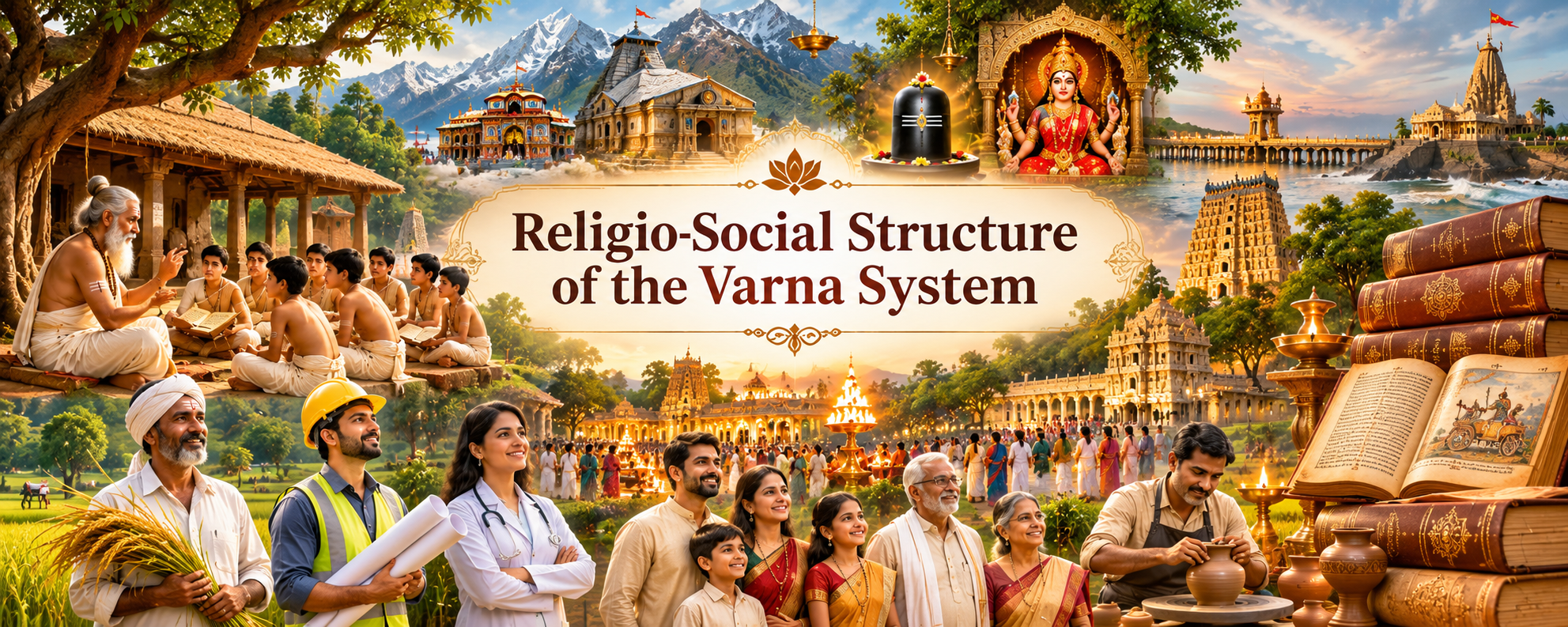
It describes how customs, traditions, rituals, religious events, ceremonies, celebrations, and festivals are practised in social life, and how religious beliefs cannot be separated from social life.
The combination of religion and social factors and their religio-social status, authority, position, and the Brahmin Varna, and the members of all the four Varnas together form a social structure.
For instance, communal rituals such as prayers, puja, yajna, bhajan, kirtan, and sadhana unite participants as well as the world into a communion.
Religion, through the religio-social structure of living society, provides individuals with a shared set of beliefs and values that guide their functioning and bind them together within that structure. Religion, as part of the religio-social structure of a living society, reflects and sustains the shared state of consciousness of the social organism.
Institutions as a Component Part of Religio-Social Structure
All the members of the four Varnas share common institutions of the religio-social structure of society.
From a sociotrilogical perspective, the institutions or organs of the religio-social structure are:
Veda Pathashalas and Gurukuls
Traditional religious education and the training of students who choose the spiritual path.
Temples and Sacred Centres
Shared religious spaces associated with darshan, rituals, pilgrimage and communion.
Sacred Destinations
Chardham sites, Jyotirlingas, Shakti Peethas and other major temples.
Holy Scriptures and Texts
The depository of values, teachings and religious knowledge.
Ecclesiastical Authority of Brahmin Varna
The governing and administrative institution that organises, manages and supervises the component parts of the Religio-Social Structure.
Veda Pathashalas and Gurukuls
These are specialized religious schools where students who choose the spiritual path are trained to become Purohits, Pandits, or Pujaris. They undergo intensive traditional schooling.
Temples: Common Centres of Communion
Temples are common centres of re-energizing and realizing the conscious experience of communion, fostering inner peace and tranquillity through darshan.
Darshan is a way of experiencing communion in which the devotee looks at the deity, and the devotee’s gaze is understood to be reciprocated by the deity. Through this mutual act of seeing, the devotee experiences a convergence of consciousness and communion with the divine.
(a) Chardham Pilgrimage Sites
Four sacred destinations across the cardinal directions.
Chardham pilgrimage sites established across the four cardinal directions:
(b) 12 Jyotirlingas
Sacred shrines associated with Lord Shiva.
The 12 Jyotirlingas of Lord Shiva are sacred shrines of Hinduism spread across India, where Shiva appears as a pillar of light and is worshipped as a symbol of communion.
Lord Shiva and Mahākāla
Lord Shiva represents the sustainer of life and the destroyer of physical or material objects and forms, rather than the destroyer of life itself. According to the laws of nature, everything in the physical realm that begins to exist must eventually come to an end.
The arrow of time and the entropy associated with physical phenomena reflect the inevitable reality of change and transformation. Lord Shiva is also represented as Mahākāla, the Lord of Time, symbolizing the ultimate power of time over all physical forms and the cycles of creation, preservation, and dissolution.
The 12 Jyotirlingas
(c) Shakti Peethas
Sacred pilgrimage sites associated with Shakti.
The 51 Shakti Peethas are sacred Hindu pilgrimage sites spread across South Asia and the Indian subcontinent (primarily India, Nepal, Bangladesh, and Pakistan).
In this context, Shakti is understood as the cosmic force of energy, nature, and the dynamic interplay of Sattva, Rajas, and Tamas (the three gunas).
Notable Shakti Peethas
(d) Major Temples
Major temples and sacred destinations form part of the religious-social structure described in this framework.
All these temples and many others, including yoga and meditation ashrams and centres, are the complementary parts of the religious-social structure.
Holy Scriptures and Sacred Texts (as a component part of religio-social structure)
Hindu Scriptures and Knowledge Traditions
The Four Vedas
Brahmanas and Aranyakas
The Upanishads
The Six Vedangas
The Ramayana
The Mahabharata and Bhagavad Gita
The Puranas
Bhakti and Regional Sacred Literature
Ecclesiastical Authority of Brahmin Varna
It is a broad institution or governing power held by Brahmin Varna. A union of administration and a body of financial management authority of Religio-Social Structure.
It organises, manages and supervises all the component parts, like Veda Pathashala or Gurukul, major temples and pilgrimage sites, scriptures and sacred texts, and people of all the Four Varnas.
It manages the operation of Functional Unity of people of Religio-Social Structure of Society.
It ensures or guarantees the Fundamental Rights of religio-social justice to all the people of Four Varnas, irrespective of their background.
Man, as a Religio-Social being, is a legitimate member of Religio-Social Structure of Society.