Karya Karana Yogism as a Basic Structural Principle of the Communion Constitution of the Varna System
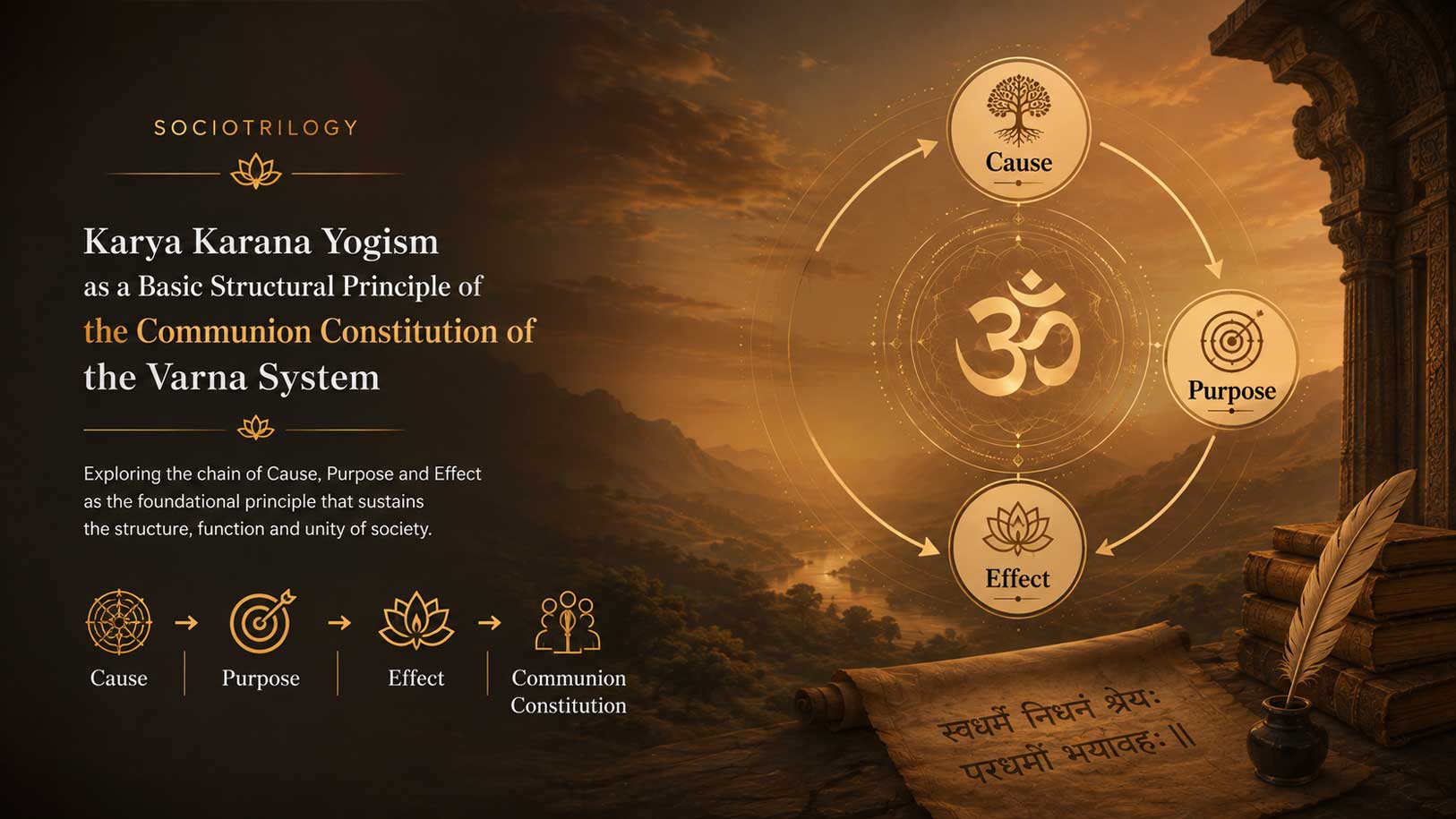
Karya Karana Yogism presents a structural framework of cause, purpose, and effect relationships within the Communion Constitution of the Varna System.
Cause
Brahmin VarnaIntelligent Cause — Nimitta Karana.
Purpose
Kshatriya VarnaTo maintain, preserve and protect the social structure.
Effect
Vaishya VarnaSustaining the social structure and enabling its dynamic continuity.
Karya Karana Yogism
Karya Karana is a philosophical concept found in the Upanishadic texts. It regards reason and purpose as primary sources and tests of knowledge, thereby prioritizing logic, intellect, thought, internal coherence, and innate concepts.
Karya Karana Yogism is a firmly established framework of cause-purpose-effect relationships. As a structural principle of the Varna System, it comprises three structural elements—cause, purpose, and effect.
The first three Varnas respectively represent the cause, purpose, and effect dimensions of Karya Karana Yogism. The fourth Varna is an inseparable and integral part of these three Varnas.
Varna
Varna
Varna
Inseparable and Integral Part of All Three
Varna System as the Communion Constitution
The Varna System, as a constitution of communion, is the union of three conscious states of living society. The horizontal division of the fourfold Varna System forms the social organism of the communion constitution.
Intelligent Cause
Nimitta Karana — Brahmin Varna shapes the form and structure of the social system.
Purpose
Kshatriya Varna maintains, preserves and protects the social structure.
Effect Dimension
Vaishya Varna sustains the social structure and enables dynamic continuity.
Fourth Varna
Shudra Varna is an inseparable and integral part of all cause-purpose-effect dimensions.
Brahmin / Intelligent Varna
Within Karya Karana Yogism as a fundamental structural principle, Brahmin Varna is understood as the causal dimension (Nimitta Karana) of the Varna System.
At the level of social structure, this intelligent force shapes and directs the creation of the social structure and therefore constitutes the cause dimension.
The Brahmin/Intelligent Varna is driven by a dominant state of Sattva Guna.
Kshatriya Varna
Kshatriya Varna represents the purpose dimension within Karya Karana Yogism.
Its role is to maintain, preserve, and protect the social structure or the state.
The purpose dimension maintains, preserves, and protects the social structure.
Prime Minister, Governor, President, Legislative Members, Political Parties
Army, Navy, Airforce, Security Personnel
Policeman, Judiciary, Courts
Vaishya Varna
Within the structural principle of Karya Karana Yogism, Vaishya Varna occupies the position of the effect dimension of the Varna System.
Vaishya Varna comprises people engaged in occupations whose function is to sustain human life and the social structure of living society.
Vaishya Varna is an economic backbone of society or the state: it sustains human life and contributes to social or state growth and prosperity.
Merchants
Industrialist
Doctor Fraternity etc.
Shudra Varna
Shudra Varna is the fourth occupational class. It is the ancillary Varna that supports the other three Varnas in the performance of their primary functions.
It consists of unskilled, semi-skilled, and skilled labor involving physical or mental effort directed towards producing goods or providing services.
Semi-Curve of the Symbol ॐ
The semi-curve at the top of the symbol ॐ represents illusory power.
It is the power of creation, maintenance and sustenance, or destructive creation, within cosmic existence.
The three curves of ॐ represent the three states of consciousness associated with the physical existence of the cosmos.
Fourth State of Consciousness
The dot above the semi-curve represents ultimate consciousness.
The fourth state of consciousness is a state of pure peace. Despite conflicts, crises, wars and discordant voices within society, ultimate consciousness represents a state of pure peace in living society.
Harmony
A state of harmony within living society.
Equilibrium
A state of equilibrium and dynamic stability.
Peace & Bliss
A state of pure peace and bliss.
Self-Control
A conscious state of inner balance.
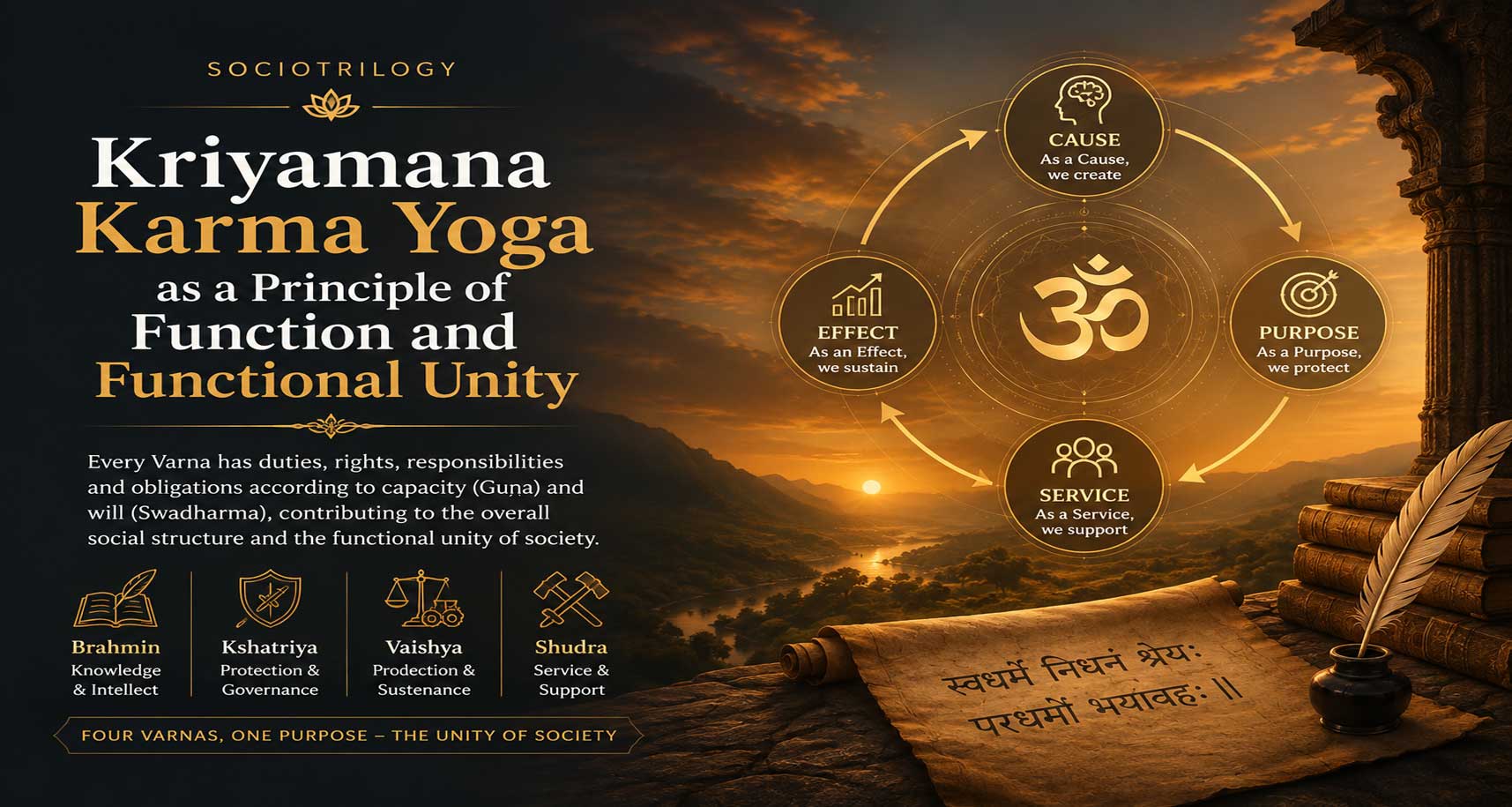
Kriyamana Karma Yoga
Kriyamāṇa Karma means the actions performed in one’s present life through the exercise of free will.
Free Will: These are the actions in which one engages through thoughts, words, and deeds, including everyday routine work, professional activities, occupational duties, responsibilities, and obligations.
Shaping the Future: Present actions may produce immediate results or yield results in the future. For example, bathing brings freshness, while sustained hard work may lead to success in life.
Power of Change: Kriyamāṇa Karma is fully under one’s control and operates on the basis of Kriyā Kāraṇa (cause and effect).
For example, engaging successfully in business may create wealth, while diligent study may enable a person to become a renowned scholar.
Kriyamana Karma Yoga
Kriyamāṇa Karma Yoga is a form of materialism with a spiritual overtone. It seeks to balance one’s own life with the well-being of human life and society by emphasizing the selfless performance of one’s duties, without attachment to results. Through one’s actions, one serves the lives of others, while results arise as natural consequences.
The orientation of Kriyamāṇa Karma Yoga is towards serving the lives of others alongside one’s own life; the results of action are regarded as natural consequences.
Within Kriyamāṇa Karma Yoga, cause, purpose, and effect are firmly established as a “law of nature.” Any change in one affects the other two interrelated and correlated components of the causal chain of Kriyamāṇa Karma Yoga. In this sense, purpose and effect are interrelated consequences vis-à-vis the cause.
Definition of Kriyamana Karma Yoga
Kriyamāṇa Karma Yoga refers to the performance of duties and responsibilities with complete dedication and commitment, without selfish motive, for the purpose of serving human life and human society, and without attachment to a possessive obsession with results, rewards, wealth, material achievements, name, fame, glamour, or success.
Significant Characteristic Nature of Kriyamana Karma Yoga
1. Purpose-Oriented:
The actions of Kriyamāṇa Karma Yoga are purpose-driven and focus on the underlying objective of serving human life. They emphasize a deep and meaningful connection between work, responsibility, and one’s contribution to the growth and development of a living society or state.
2. Dharma as a Governing Principle:
Dharma provides a framework of duties, rights, and legal obligations in relation to the action performed.
Every action within Kriyamāṇa Karma Yoga is associated with a status and role. A person occupying that status and performing that role exercises corresponding duties and rights and fulfils the obligation to comply with rules, regulations, codes of conduct, and procedures.
3. Detachment from Possessive Obsession with Material Achievement:
The most important characteristic of Kriyamāṇa Karma Yoga is detachment from a possessive obsession with material achievement. A possessive obsession with material achievement is an extremely protective and dominating attitude or form of behavior arising from achievements such as wealth, property, high status, power, skills, talent, and intellect, which a person seeks to exercise over others. It manifests as an extreme urge to control and dominate others. Possessiveness arises from an excessive love of material achievement, while obsessiveness stems from the fear of losing such achievement, as well as from greed, anger, and attachment. Detachment from possessive obsession is therefore the central tenet of Kriyamāṇa Karma Yoga.
4. The Performer Is Just an Instrument of Kriya Karana Yogism:
The performer of Kriyamāṇa Karma Yoga is merely an instrument who uses nimitta kāraṇa (the efficient cause), intellectual resources, or natural resources as causes in performing a role that produces an “effect” and achieves the purpose of serving human life.
Example 1:
A writer uses his intellect and talent as a cause to write a book on the economy of the country; the book is an “effect.” The writer thereby serves the “purpose” of enriching people’s lives through knowledge.
Example 2
A farmer uses land, soil, water, urea, and the mind as causes and cultivates the land to produce food grains as an “effect,” thereby fulfilling the “purpose” of sustaining human life.
Understanding the Communion Constitution
Karya Karana Yogism presents the Varna System through interconnected cause, purpose and effect dimensions, with the fourth Varna forming an inseparable and integral part of the whole structure.