Sociotrilogy: Organismic Theory of Society
An exploration of society as an interconnected organism through Purush Sukta, the Varna system, OM, communion, and Karya-Karana Yog.
01 · Foundation
Society as an Organism
Man is a social being. He lives in groups and communities within the social structure of society. Man is biologically and psychologically equipped to live in groups in society. Society has become an essential condition for human life to exist and grow as a social being.
The idea of the organismic analogy of society is derived from the Rigveda Purush Sukta, an ancient Sanskrit hymn in the Rigveda. It presents the nature of ‘Purush’, a cosmic being, as both immanent in the manifestation of the world and yet transcendent in the form of ultimate consciousness.
The first movement or vibration within the ultimate consciousness generated a sound, which was “OM”. This constitutes the composition of communion.
A seventh verse of Purush Sukta hints at the organismic interconnectedness of various Varnas or classes of human society.
02 · Primordial sound
OM (ॐ): Composition of Communion
OM is a sacred syllable, mantra, and universal symbol in Indian religion.
It is a primordial sound of vibration, of the universe, encompassing the entire universe. It represents the unity of existence and ultimate consciousness; it constitutes a composition of communion (Ekatvam, or Advait, meaning oneness).
Meaning and Symbolism
The primordial sound is considered the sonic representation of Karya-Karana Yoga, the divine and the original vibration from which the whole universe emerges. Communion is the fundamental reality of interconnected consciousness of the Varna system.
ॐ (AUM) is a symbol composed of three distinct sounds: the first sound, pronounced “A” (अ), followed by “U” (उ) and “M” (म्).
Each sound represents one of the three states of consciousness of the universe and the Varna system. The union of these three states of consciousness transcends into ultimate consciousness (the consciousness of the observer).
03 · Social composition
Composition of Society (Varna System) Based on ॐ (OM)
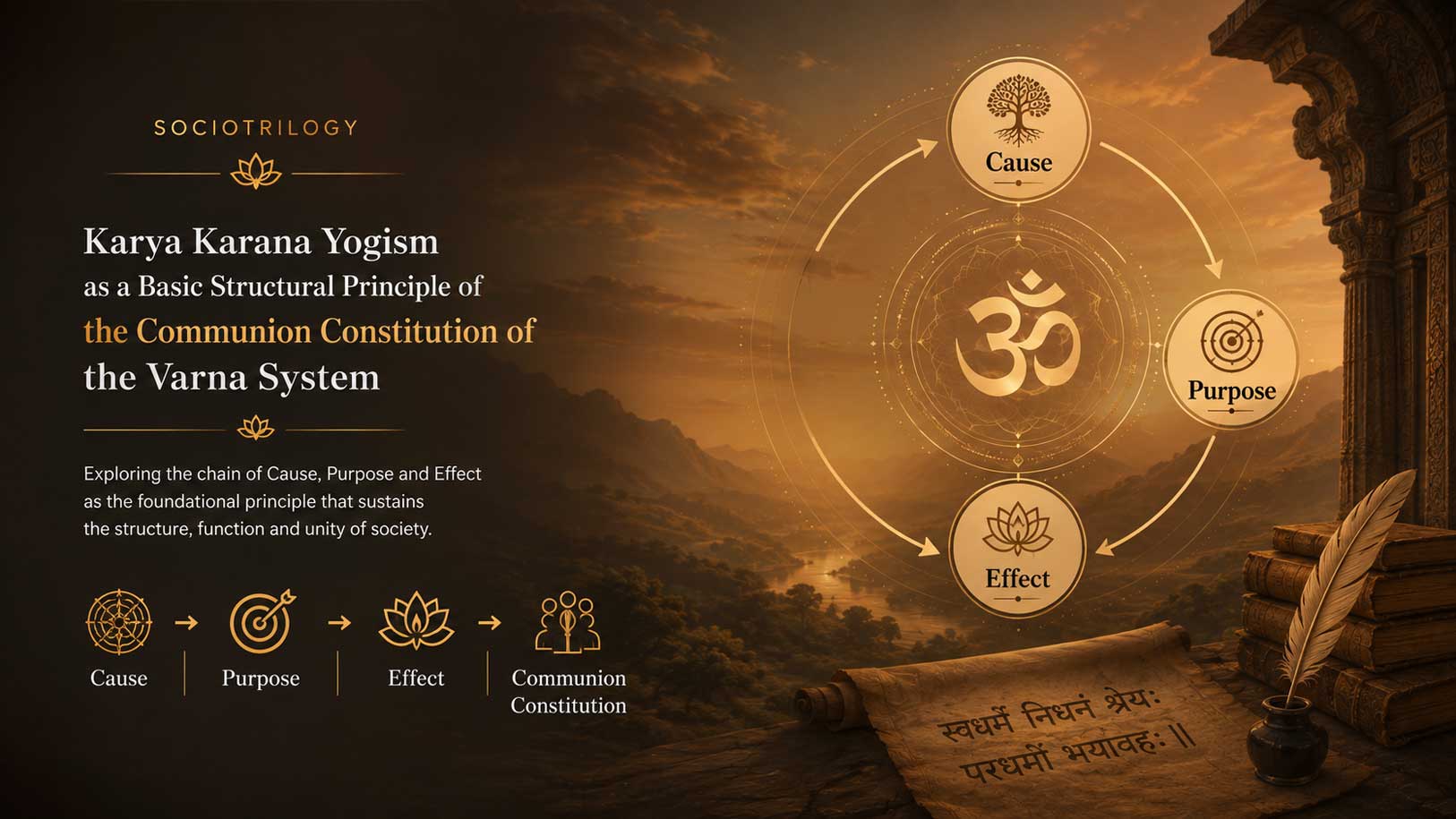
Purush Sukta is cited in the Rigveda and describes the composition of society through the Varna system, based on the basic principle of Karya-Karana Yog (cause–purpose–effect relationship).
That is, ॐ (AUM), which is the communion constitution of the Varna system. It divided human society into four classes called Varnas.
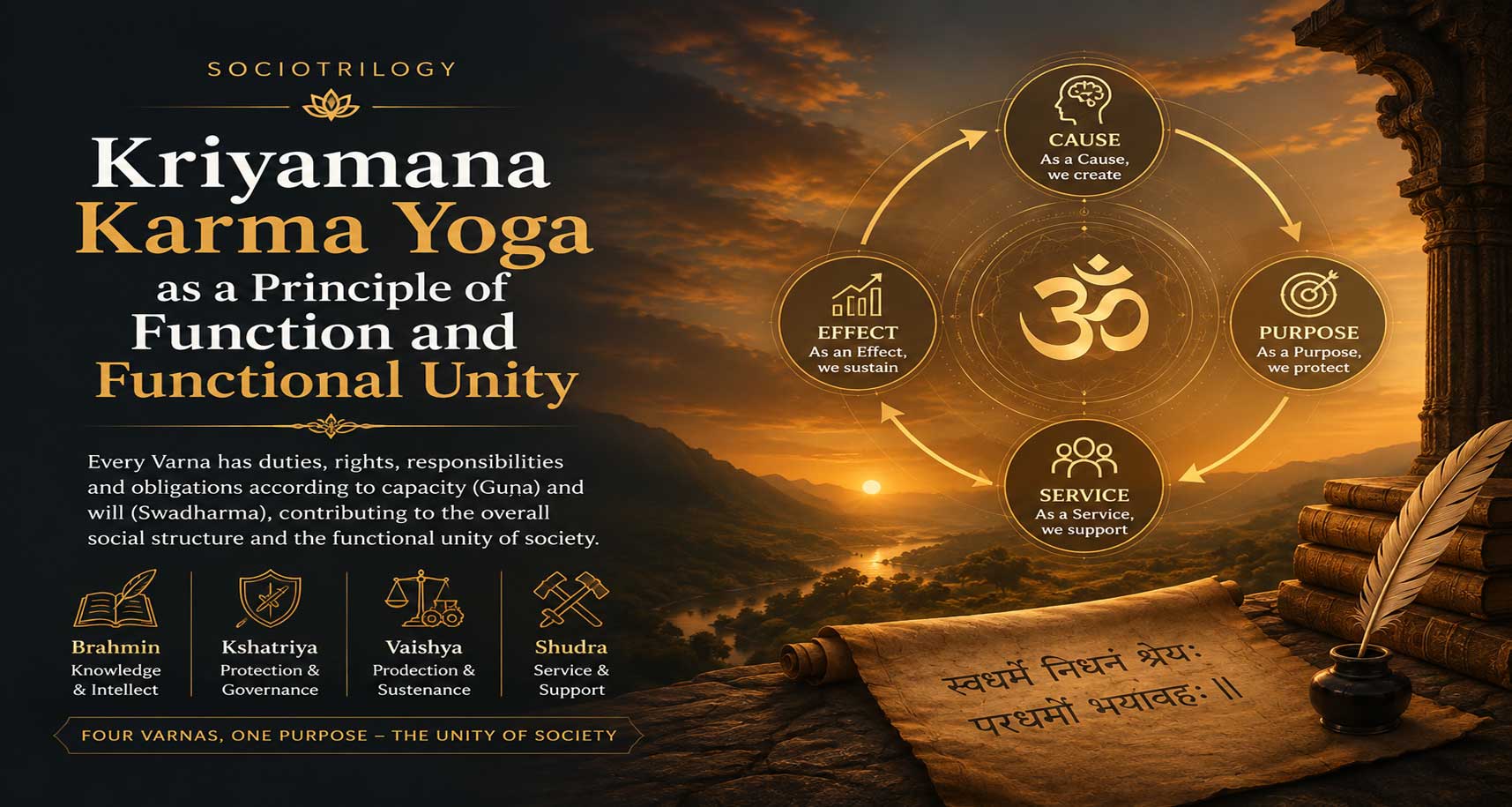
The four-fold Varna system, as described in the notes, includes:
Brahmins
Intellectual / Creative class
ExamplesTeachers, scholars, priests (Purohits), saints, maharishi, philosophers, researchers, scientists, inventors, authors, poets, writers, including all creative people, and spiritual guides.
FunctionThey shape the form and structure of society.
Kshatriyas
Kings, warriors, and rulers
ExamplesKings, warriors, soldiers, military leaders, police officers, administrators, politicians, public safety officials, prime ministers, ministers, and so on.
FunctionThey maintain, preserve, and protect the social structure of society or state.
Vaishyas
Farmers, businesspeople, skilled workers, and service providers
ExamplesFarmers, traders, merchants, entrepreneurs, business owners, technology entrepreneurs, software product creators, expert service providers, logistics service providers, doctors, the medical fraternity, the judicial fraternity, and technology innovators.
FunctionThey sustain human life and living society to maintain the dynamic continuity of the social structure of society or state.
Shudras
Labourers and service providers
ExamplesConstruction workers, skilled, unskilled, and semi-skilled workers, artisans, carpenters, electricians, plumbers, mechanics, technicians, machine operators, manual service providers, and technical service providers.
FunctionThis is the ancillary Varna, supporting all the above three classes of Varna in their primary function to renew, maintain, and sustain the social structure of society or state.
04 · Three sounds
The A-U-M Triad
The syllable breaks down into three core phonetic components, representing the universal states or the Varna system of society.
Ah · Waking / Formation
It represents the waking state of consciousness at the individual level, creation at the cosmic level, and the beginning or the formation of a Brahmin conscious state. It also represents the beginning of cellular organization at the organismic level.
Ooh · Dream / Structure
It represents the dream state of consciousness at the individual level, the Kshatriya state of consciousness in Hinduism, and, in physics, gravitation and the cosmic web at the cosmic level.
Mmm · Deep Sleep / Transformation
It represents the deep-sleep state of the subconscious mind at the individual level and the ultimate state of consciousness at the universal level. It is the state of consciousness of the Vaishya Varna and of transformation, since it is driven by the arrow of time (Mahākāla).
In Hinduism, it represents Lord Shiva's conscious state. In physics, it represents the creation and destruction of stars, supernovae, and black holes. In the Varna system of society, it represents the Vaishya Varna state of consciousness.
The fourth Varna, Shudra, represents the integral part of the system and the indispensable part of all three Varnas. It is present in all the sounds of ॐ (AUM) and represents the Shudra Varna of the Varna system of society.
It is the foot or foundation of the existence of society. Without it, the existence of society as a whole would be impossible.
05 · Reading the symbol
The A-U-M Symbol: ॐ
The Devanagari script ॐ is the classic representation of the totality of cosmic existence, including the Varna system and organismic structure.
It represents the four states of consciousness and the Maya, the illusory power that projects the entirety of cosmic existence. The dot at the top represents ultimate consciousness.
Every curve of the Devanagari script ॐ represents the union of the three states of consciousness of cosmic existence, and the semicircle above represents the illusory power. The dot at the top represents ultimate consciousness.
The three curves, a semicircle, along with the dot at the top, form a composition of communion, as follows:
Lower Curve of ॐ
The lower curve of the symbol ॐ in the Devanagari script represents the sound “A” (Ah), which signifies the waking state of consciousness at the individual level.
It represents Brahma (Chaturmukhi) at the cosmic level in Hinduism, and the Brahmin state of consciousness in the Varna system of society.
In physics, it is the beginning of the crystallization processes of the cosmic field and cellular organization at the organismic level.
The individual waking state is essential for experiencing physical phenomena.
Middle Curve of ॐ
The middle curve of the symbol ॐ represents the sound ‘U’, which signifies the dream state of subconsciousness, during which breathing and other bodily functions continue.
Within the Varna system, the ‘U’ sound represents the Kshatriya state of consciousness.
At the cosmic level, the ‘U’ sound represents the cosmic web and gravity, which sustain the cosmic structure as a state of Lord Vishnu’s consciousness.
Upper Curve of ॐ
The upper curve of ॐ represents the sound ‘M’, which signifies the deep-sleep state of subconsciousness.
In this state, bodily functions, including blood circulation, continue normally.
The manifestation of black holes and supernovae, together with the destruction and reformation of stars in the cosmos, is represented by the upper curve and the ‘M’ sound of ॐ, signifying Lord Shiva’s state of consciousness.
Within the Varna system, the ‘M’ sound of the symbol ॐ represents the Vaishya Varna state of consciousness.
Semi-Circle of ॐ
The semicircle at the top appears separate from the dot.
This semicircle represents Maya—the illusory power that projects cosmic existence.
Beyond the triad
The Fourth State of Consciousness
The dot above the semicircle in the symbol ॐ represents the source and the ultimate state of consciousness (the conscious observer).
It is a state of pure peace, bliss, harmony, equilibrium, and the dynamic stability of living society.
The three curves represent distinct states of consciousness within the cosmic unity of physical reality, which transcend into the highest, most inclusive, and holistic state of ultimate consciousness.
All the curves share a single underlying ultimate consciousness (the conscious observer).
Editorial note: This page presents the concepts and mappings as described in the Sociotrilogy framework. The connections drawn here between the Varna system, states of consciousness, Hindu deities, and physics are part of this framework and should not be read as universally accepted interpretations.
ॐ (OM): Three Curves, the Semi-Curve, and the Dot
Within the Sociotrilogy framework, the form of ॐ is read as a visual expression of the three states of consciousness, their functional interconnection, and the transcendent fourth state.
The symbol as a model of consciousness
In the proposed interpretation, the sounds “A,” “U,” and “M” and the three curves of ॐ represent the conscious states associated with Brahmin, Kshatriya, and Vaishya Varna. Shudra Varna is represented as an integral part of all three.
The semi-curve is associated with Maya, or illusory power, while the dot above it represents ultimate consciousness—the fourth state.
Reading the semi-curve and the dot
Semi-curve: Maya
The semi-curve at the top of ॐ represents illusory power, associated in this framework with creation, maintenance, sustenance, and destructive transformation.
Pure peace
The dot above the semi-curve represents ultimate consciousness, described as pure peace despite conflicts, crises, wars, and discordant voices within society.
Harmony
Despite diversity in nature and human existence, ultimate consciousness represents harmony within living society.
Equilibrium
Ultimate consciousness is described as equilibrium within the cycle of creation, maintenance, and transformation or destruction as part of renewed creation.
Peace and bliss
At the level of individual experience, ultimate consciousness is described as perfect happiness, peace, and pure joy.
Self-control
Self-control is the state in which the mind is under one’s control, rather than the individual being controlled by the mind. It includes regulating emotions and resisting harmful impulses.
“Brahma Satyam Jagan Mithyā” is included in the supplied framework to express the idea that cosmic existence is illusory while Brahman is ultimate truth.