Sanātana Sociotrilogy
Dharma as a Mechanism of Social Governance
The normative principle of duties, rights, reciprocity and social order
Dharma constitutes the normative and governing principle, or law, of the Varna System. It provides a moral, ethical, and legal framework of duties, rights, and obligations that upholds and sustains the order of the social system. Dharma denotes a governing principle considered to accord with Ṛta—the cosmic order. The Varna System is viewed as a social template of Ṛta.
01 · Foundational meaning
Meaning of Dharma
Dharma and Ṛta: Dharma denotes a governing principle considered to accord with Ṛta—the cosmic order. The Varna System is viewed as a social template of Ṛta.
02 · Sociotrilogical perspective
Dharma as Reciprocal Interaction
From a Sociotrilogical perspective, Dharma is both a mechanism of reciprocal interaction and a framework of duties, rights, and obligations. It regulates relations between individuals, between individuals and groups, and among groups through their respective statuses and roles. Social life functions more smoothly when rights and duties operate together as complementary principles and when participants fulfil their obligation to comply with the rules, regulations, and laws governing those rights and duties.
Rights
Rights represent what individuals legitimately expect others to do for them.
Duties
Duties are the actions individuals are expected to perform for others in accordance with the prescribed rules, regulations, laws, or codes of conduct governing those actions.
03 · Social-system mechanism
Dharma as a Mechanism of a Social System
Dharma is a mechanism of reciprocal interaction among people that maintains and sustains social order. The framework of duties, rights, and reciprocity—together with the obligation to comply with the rule of law and the procedures regulating such reciprocity—constitutes the mechanism of Dharma. This mechanism upholds, maintains, and sustains the social structure, individual behavior, and the functional unity of the living society/state.
Duties in reciprocal practice
These represent both moral and legal responsibilities. They specify what individuals are obliged to do for others or for society in the mutual expectation that their corresponding rights and entitlements under the law will be fulfilled.
For example, paying taxes is an individual’s duty; in return, the individual expects the government to fulfil the entitlements associated with taxation, including the provision of necessary infrastructure and the performance of other governmental functions for the public good. Both parties are bound by the obligation to follow the rule of law.
Dharma may be divided into two dimensions: (1) Moral – duties, rights, and obligations; and (2) Legal – duties, rights, and obligations.
04 · Moral dimension
Moral Duties and Moral Rights
Moral Duties
Moral duties are obligations to act on the basis of inner conviction or social and cultural norms and values rather than legal enforcement. They arise from an internal sense of right and wrong, and a person generally cannot be legally punished for failing to perform them. Moral duties represent what a person ought to do to prevent harm, ensure fairness, and promote the well-being of others—for example, respecting elders and assisting persons with disabilities.
Moral Rights
Moral rights are grounded in conscience and in social and cultural norms and values rather than in legal enforcement. They derive from an internal understanding of good and bad, and a failure to honor them does not necessarily result in legal punishment. Moral rights represent what a person may reasonably expect from others. Every person has a basic moral right to get respect, dignity, fair treatment, faithfulness, truthfulness, and non-discrimination.
For example, children have a moral right to basic necessities such as food, clothing, and shelter, regardless of whether these are provided by parents, non-governmental organizations, or the government; what matters to the child is that these necessities are provided.
05 · Social ethics
Obligation of Social Morality
Compliance with moral rules, norms, values, and cultural ethics is necessary for participation in human society. In this sense, Dharma functions as a form of social morality.
What is social morality?
“Social morality” refers to the ethics governing human conduct and behavior in society. It comprises the rules, cultural norms, and values that regulate how members of society behave toward one another for the well-being of all.
06 · Norms and values
Norms and Values of Social Morality
Honesty and trustworthiness
This principle requires telling the truth in daily conversations and dealings across all areas of life and avoiding cheating, fraud, scams, and the exploitation of others.
Respect for elders and vulnerable people
It involves showing respect for parents, teachers, elders, and senior citizens, and assisting those who are unable to care for themselves, including persons with disabilities.
Empathy and charity
Empathy and charity include donating money or goods to people in need and distributing food and clothing to people affected by malnutrition or poverty. Contributions made during emergencies or natural calamities, such as floods and earthquakes, assist people in distress.
Fair play and etiquette
The equal treatment of all human beings, the rejection of attempts to obstruct the success of others at any cost, and respect for individual personality and achievement are important principles. This principle also requires politeness and appropriate behavior within social groups, communities, school classrooms, and other collective settings.
Tolerance and inclusion
Tolerance and inclusion involve embracing unity in diversity and the oneness of society despite differences in cultural beliefs, while opposing discrimination based on class, caste, gender, religion, language, or region.
Cleanliness and a healthy environment
Personal hygiene includes bathing regularly, washing one’s hands when necessary, wearing clean clothes, maintaining one’s hair, and keeping the home clean and orderly.
Civic sense plays an important role in maintaining a healthy environment. It reflects the social conscience and ethical behavior that individuals practise in daily life to promote cleanliness, prevent disease, and support the well-being and happiness of society as a whole. Examples include disposing of waste in public garbage bins and refraining from open defecation or urination.
07 · Legal dimension
Dharma as a Legal Framework of the Varna System
Dharma is a legal framework of duties, rights, and obligations associated with the statuses and roles of the Varna System. As a normative or legal principle, Dharma regulates, controls, and governs the relationships among social statuses and roles, including the duties attached to them. Within the Varna System, the nature of these duties, rights, and obligations is determined according to a person’s social status and role.
The Varna System determines the reciprocal mechanism of duties, rights, and obligations attached to a person’s social status and role on the basis of guṇa and karma.
08 · Social structure
The Varna System’s Social Statuses and Roles (Duties)
Social status
This refers to the position that an individual occupies in relation to a particular role, such as that of a teacher, doctor, or prime minister. Social statuses exist within the structure of society, and individuals occupy them.
Social role
A social role is the function associated with a status, or the manner in which an individual performs the duties of that position—for example, teaching students, treating patients, or governing a country.
09 · Relationship and change
Interrelationship Between Status and Role
1. The term “role” and “status” are interrelated
A status is the position that a person occupies in society, whereas a role is its behavioral aspect. A status is occupied, and a role is performed. A role is the manner in which an individual fulfils the duties attached to a status and exercises its rights, privileges, and prerogatives while remaining subject to the law—that is, while following the rules and regulations associated with the relevant status and role. A position or status therefore serves as a means of identifying a particular social role.
2. Role is a relational term
An individual performs a role in relation to the role of another person. For example, a doctor performs the duties of diagnosis and medical treatment in relation to the patient’s duty to pay for those services.
3. Status or role is called “Swadharma”
Swadharma is an acquired position and role that a person earns through skills, effort, and merit, based on Guna and Karma. Such a role is aligned with the person’s innate or natural talent—for example, a teacher’s capacity to acquire knowledge and teach others. “Teacher” denotes the person’s status, while acquiring the knowledge and proficiency required to teach denotes the associated role. Together, this status and role constitute the person’s Swadharma as an acquired status and role.
4. Both status and roles are dynamic and constantly changing (within the varna)
Accordingly, a role may change with each new incumbent occupying a status. A status also changes when the duties, rights, and obligations attached to it are altered. Over time, new duties and responsibilities may be added, while older ones may be removed. More rigorous role performance may sometimes expand the functions associated with a status. For example, when an association increases in size, its office-bearers may acquire new statuses, and new statuses and roles may be established. Both status and role are dynamic within social life; however, statuses are structural and cultural, whereas roles are behavioral in nature.
10 · Practical operation
How Dharma Operates as a Mechanism of Reciprocity
Dharma is a mechanism of reciprocal interaction among people. It is a legal framework comprising duties, rights, and obligations under law, through which the social system is regulated and controlled.
1. Duties
Duties represent the legal responsibilities that individuals are obliged to fulfil for others according to their status and role, in the mutual expectation that their rights or entitlements under the law will be recognized.
The obligation of law is a binding force upon both parties to an interaction. The fundamental purpose of reciprocal duties and rights, together with the obligation of law, is to serve human life and the living society as a whole.
For example, paying tax is the duty of an eligible taxpayer; in return, the taxpayer expects the government to fulfil corresponding entitlements, such as providing necessary infrastructure, ensuring an adequate supply of essential goods, controlling inflation, and performing other governmental functions for the public good. Both the government authority and the taxpayer are bound by the law of the country.
2. Rights and privileges
Rights and privileges represent a person’s legal entitlements in reciprocal relation to the duties or acts that the person has performed. They determine what an individual may legitimately receive in exchange for fulfilling those duties. A right is a legitimate power or entitlement of the performer.
For example, a manufacturer produces and sells goods in accordance with legal requirements and earns income or profit as a legitimate right. Similarly, a customer or consumer fulfils the duty of paying for a product purchased to satisfy a need and, in return, legitimately expects the manufacturer to provide a product that is of appropriate quality, cost-effective, safe, and healthy, as prescribed by law.
3. Obligation of law
The obligation of law refers to compliance with the rule of law. It is an ethical and legal requirement that enables members of society to exercise reciprocal duties and rights smoothly and peacefully and makes their interactions legitimate and lawful. The obligation of law binds the parties to an interaction and thereby gives legal legitimacy to the reciprocity of their duties and rights.
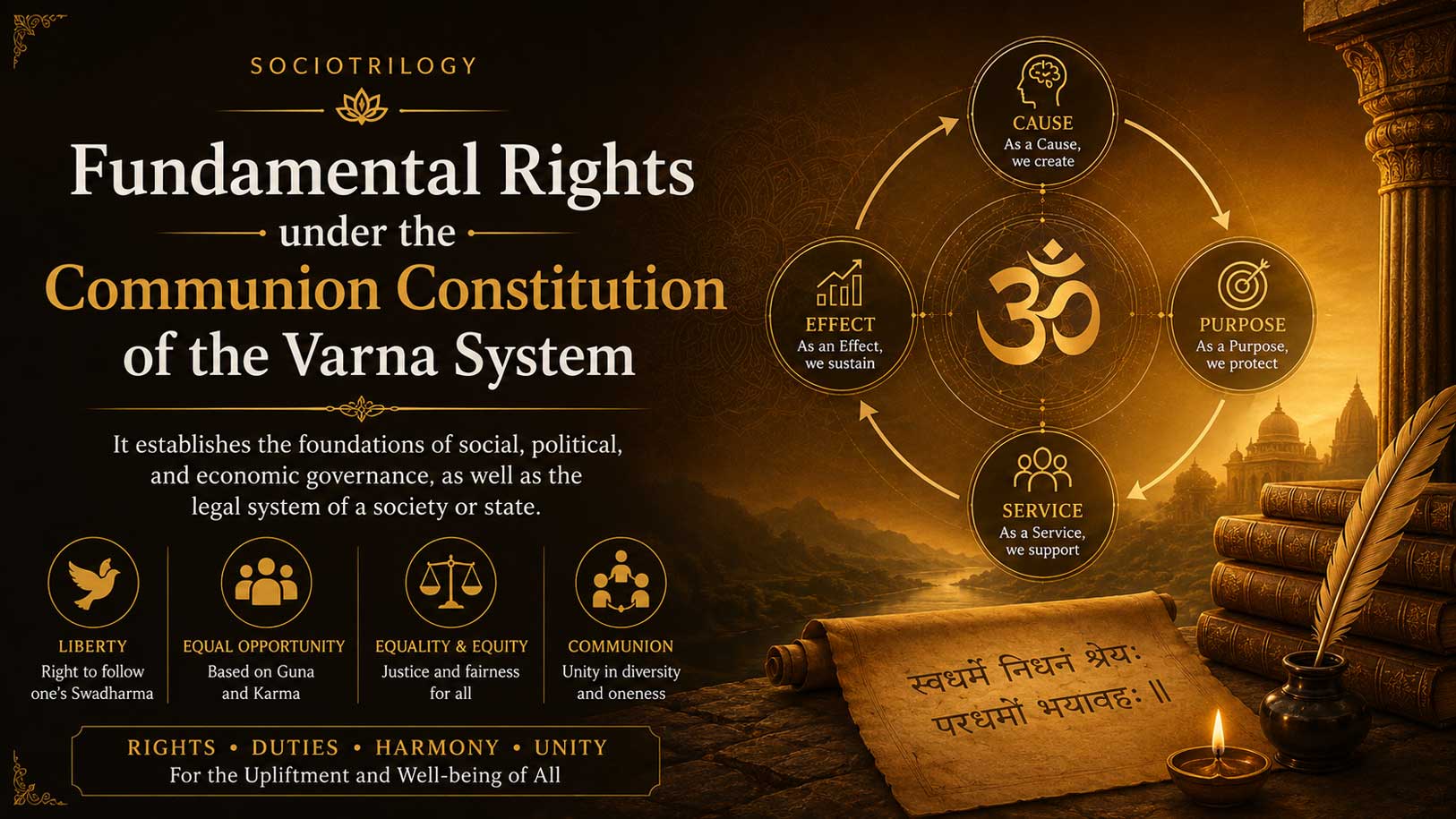
The law of the land changes over time: existing laws are amended and new laws are introduced in response to the needs and pace of an evolving society. The obligation to comply with the law of the country, as enshrined in its constitution, is an inevitable and integral part of Dharma. The same principle applies to the fundamental rights, duties, and statuses enshrined in the communion constitution of the Varna System.
Dharma, Reciprocity and Social Order
Dharma operates through the reciprocal relationship of duties, rights, and obligations. Together with the obligation to comply with law, this framework regulates social interaction and sustains the structure and functional unity of society.