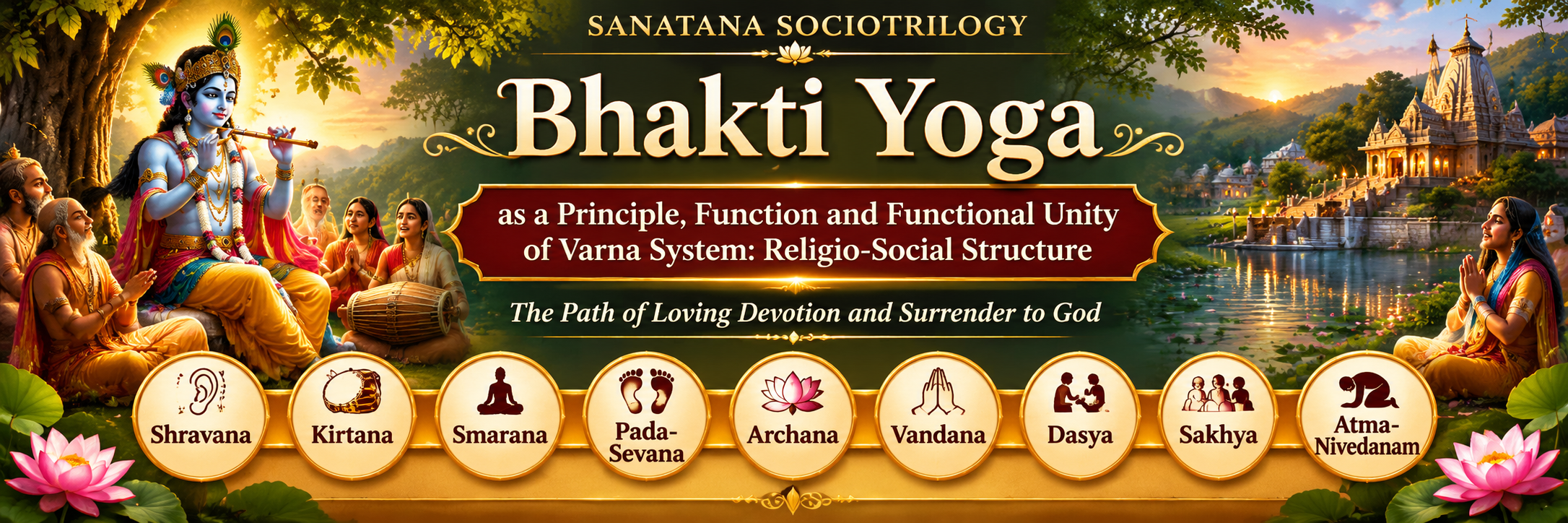
Bhakti Yoga is a spiritual path of loving devotion and surrender to God.
Core Principles of Bhakti Yoga
Love as a path and process to experience God.
Practitioners cultivate a personal relationship with the Divine in communion.
Nine Forms of Devotional Function (Navavidha)
Principle: Personal Connection
Personal Connection: Practitioners cultivate a personal relationship with the Divine in communion.
Shravana
Hearing stories, scriptures or names of the Divine.
Kirtana
Ecstatic singing of devotional songs and mantras.
Smarana
Constant internal remembrance of the Divine.
Pada-sevana
Serving at the feet of the Divine or seeing divinity in others.
Archana
Rituals using icons or offerings.
Vandana
Praying, bowing and expression of humility.
Dasya
Cultivating the attitude of a humble servant.
Atma-nivedanam
Complete surrender of the self.
Bhakti Yoga
Bhakti Yoga is a spiritual path of loving devotion and service directed towards the Divine in communion.
Derived from the Sanskrit root bhaj (meaning to serve or share) and yuj (meaning to link or join), it translates literally into a yoga (union) of connection through loving service or yoga (union) of heart in communion.
Core Principle of Bhakti Yoga
Personal or Universal Devotion
Practitioners may direct their devotion towards a personal deity (such as Krishna, Rama, Vishnu, Shiva, Saraswati, Lakshmi, Durga, Parvati, etc.). They cultivate a personal relationship with the Divine or a universal sense of Divine presence in communion.
Function and Practice of Bhakti Yoga
Bhakti Yoga has its own cause-purpose and effect dimension as a function in the religio-social structure of society.
Bhakti Yoga as a function is expressed through daily activities that turn everyday life, in temples, Gurukul, Satsang, into an offering of love and devotional love.
Kirtan and Bhajan
Singing the sacred glories and names, chanting mantras and devotional songs at home, in temples and in places of religious pilgrimage sites.
Japa (Mantra Meditation)
Repeating sacred names or prayers, often using meditation beads.
Study of Sacred Texts
Reading, learning and reflecting on texts like Vedas, Upanishads, Vedanta, Bhagavad Gita, Bhagavat Purana in temples and Gurukul to train oneself to become Brahmin: Purohit, Pujari and Pandit.
Puja and Arati
Ritual worship of deity involving flowers, incense, light and altar.
Seva (Selfless Service)
Acting out of devotional love, seeing the divine within all living beings.
Archana
Performing ritual worship or offering.
Dasya
Cultivating the attitude of loyal and humble servants in temples and Gurukuls.
Sakhya
Developing a close personal friendship with the Divine.
Pilgrimage Sites
Devotees visit temples and pilgrimage sites for Darshan of their deities. This is the most sacred practice of Bhakti Yoga, undertaken for spiritual renewal and devotion, penance and personal transformation from Brahmin.
Receive Brahmin Sacrament Services
The performance of Samskaras (Sanskara), the sacred life-cycle rituals and Vedic ceremonies that mark key transitions in a person's life. These rituals, ranging from birth ceremonies to marriage and ancestral rites, are conducted by learned Brahmin priests.
Religio-Social Rights and Reciprocal Framework
All the practices, beliefs and functions are religio-social rights (Dharma) of every individual of the religio-social structure, ensured by the ecclesiastical authority of Brahmin Varna.
By codified statutes of Vedas, Upanishad and Bhagavad Gita, and Skandh Puran, all are eligible for Dvija status based on Swadharma, Guna and Karma, character and nobility.
In the reciprocal framework of Dharma (Duties, Rights or prerogative and rules or ritual obligation).
In exchange for ‘rights’ provided by ecclesiastical authority of the Varna System, practitioner or receiver of sacrament services offer Dakshina, Dana or donation as their duties.
Fulfilling the objective of Purushartha, i.e. Dharma and Artha.
The Purpose of Bhakti Yoga
Personal Friendship
Developing personal friendship with the Divine in communion.
Total Surrender
Total surrender of oneself (body, mind, action and soul) to the Supreme Lord in communion.
Refers to a state of deep detachment, spiritual disillusionment regarding the material world, which often turns the heart towards communion.
Functional Unity of Ecclesiastical Authority of Varna System of Brahmin Varna
Religio-social functions of the people of all Varnas and its institutions work together in the organic structure of society, in the functional unity of religio-social structure governed by the ecclesiastical authority of Brahmin Varna.
It organizes, manage, control or administer the functional unity of Dharma (duties, rights and obligation to rules, norms), Artha (financial management) of religio-social structure of four Varnas of society.
Bhakti Yoga is presented here as a principle and function within the religio-social structure, expressed through devotional practices, personal communion and the functional unity of society.