Fundamental Rights under the Communion Constitution of the Varna System
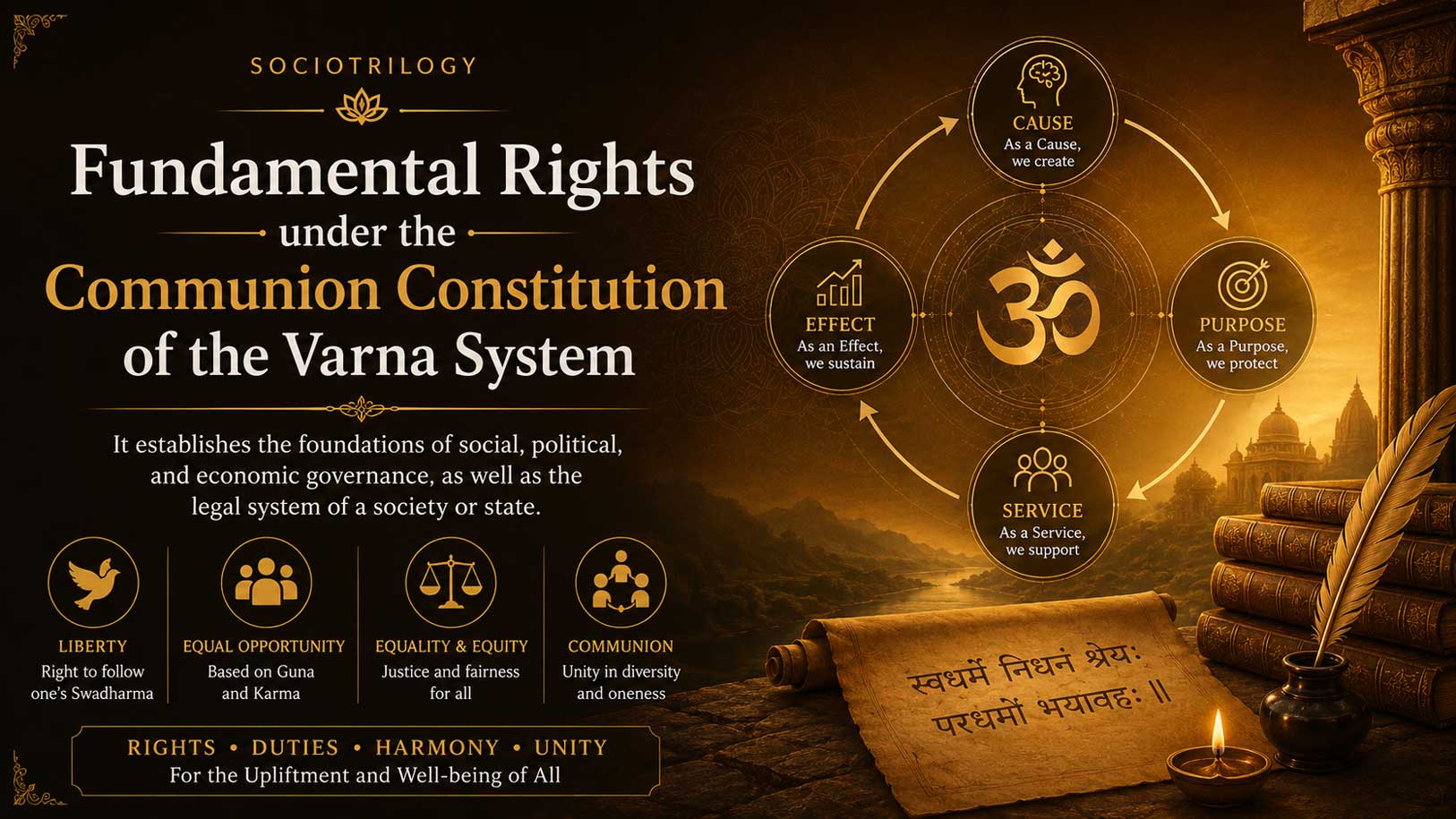
The foundational principles of liberty, equal opportunity, equality, equity, and communion within the social, political, economic, and legal framework of society.
The Three fundamental rights are Swadharma, Guna and Karma and Sarvodaya.
The Three Fundamental Rights
Swadharma
Liberty to pursue one's Swadharma according to natural disposition, talent, merit, rights and obligations.
Guna and Karma
Equal opportunity based on qualities, talents, skills and effort rather than birth or background.
Sarvodaya
The progress, equality, equity, unity in diversity and well-being of all individuals.
Swadharma — Right to Liberty
Swadharma is a Sanskrit concept. ‘Swa’ means ‘self,’ and ‘Dharma’ means ‘duties, rights, and obligations.’
It denotes righteous living aligned with an individual's proportional distribution of the Gunas (Sattva, Rajas, and Tamas), which shapes that individual's natural disposition, talent, and merit.
It determines the kind of Karma an individual should perform as an occupation in life, thereby promoting individual well-being while contributing to the continuity of the social order.
Swadharma as a Fundamental Right
Liberty to pursue one's Swadharma is a natural right arising from the human being's status as a basic unit of life within society.
Liberty to Pursue Swadharma
Swadharma empowers each individual with the liberty to access opportunities that enrich their talent, merit, and worth, without arbitrary restraint, restriction, or discrimination.
Guna and Karma — Right to Equal Opportunity
The four occupational categories of the Varna System are based on “Guna and Karma,” meaning that they are determined according to an individual's qualities and talents.
Guna
Guna refers to the qualities, characteristics and talents that shape an individual's natural disposition.
Karma
Karma refers to the activities in which an individual engages in accordance with their Swadharma.
Under this principle, success is determined by talent, skills, and effort (Karma), rather than by birth or background.
Equal Opportunity
Equal opportunity refers to open access to educational, social, political, and economic opportunities without arbitrary restraint, restriction, or obstruction.
Every individual should have an equal chance to succeed according to their Swadharma.
Right to Equal Opportunity
Equal opportunity based on “Guna and Karma” is a fundamental right of every individual.
Sarvodaya — Upliftment of All
Sarvodaya means the “upliftment of all” or the “progress and well-being of all.” It is derived from Sarva (“all”) and Udaya (“uplift” or “well-being”).
It is based on the following principles:
Right to Equality
Every individual being is a basic unit of life and a building block of the social organism of society.
Every unit of life possesses the same right to life, irrespective of gender, creed, colour, ethnicity, region, or any other distinction.
Right to Equity
Equity involves allocating resources and opportunities in varying measure according to individual needs, circumstances, or systemic disadvantages.
The purpose is to ensure that everyone has a fair chance to succeed and that inclusive growth and development can be ensured.
Right to Communion
Unity in diversity refers to people from diverse fields, possessing different talents, skills, abilities, and capacities, working together.
Their cooperation promotes harmony, peace, solidarity and unity in human life and society.
Unity in Diversity and Oneness
“Oneness” refers to communion. Communion is the fundamental reality of interconnected consciousness.
It is a deeper state of being in which the ego dissolves and a transcendent, interconnected bond of ultimate consciousness is realized.
All beings are expressions of the same source of ultimate consciousness. The same creative, maintaining, and sustaining spark of life runs through each of us and through everything on the planet; nothing exists as entirely separate.
Ātman Equals Brahman — Consciousness Constitutes Communion
Every individual consciousness consists of four states of consciousness:
Jāgrat Avasthā
Waking Consciousness
Svapna Avasthā
Dreaming Consciousness
Suṣupti Avasthā
Deep-Sleep State of Consciousness
Ultimate Consciousness
Brahman or Turīya
The mind, brain, and eyes, together with their coordination, are merely instruments of measurement within the power of illusion of ultimate consciousness (Brahman), the conscious observer.
The Four States and Communion
The union of the three states of consciousness associated with the physical world transcends into the fourth state of ultimate consciousness— communion.
Communion is the fundamental reality in which the three conscious states of cosmic existence are united within a transcendent, interconnected, ultimate state of consciousness.
Consciousness Constitutes Communion
The three conscious states of cosmic existence are united within a transcendent, interconnected and ultimate state of consciousness — communion.