Major Conceptual Perspectives of Sociotrilogy on the Varna System
Society, Structure, Dharma & Functional Unity
Major Conceptual Perspectives
The social world is understood as a structured and continuously functioning unity of living society.
The conceptual theories under consideration investigate the relationship between social structure, functional unity, consciousness, governance and the dynamic processes of society.
Varna as Social Structure
The Varna System is considered a social structure and functional unity.
Composition of Communion
Society is explored through the concept of communion and interconnected unity.
Dynamic Triguna
Sattva, Rajas and Tamas are understood as continuously interacting qualities.
Dharma
Dharma functions as a mechanism of social governance.
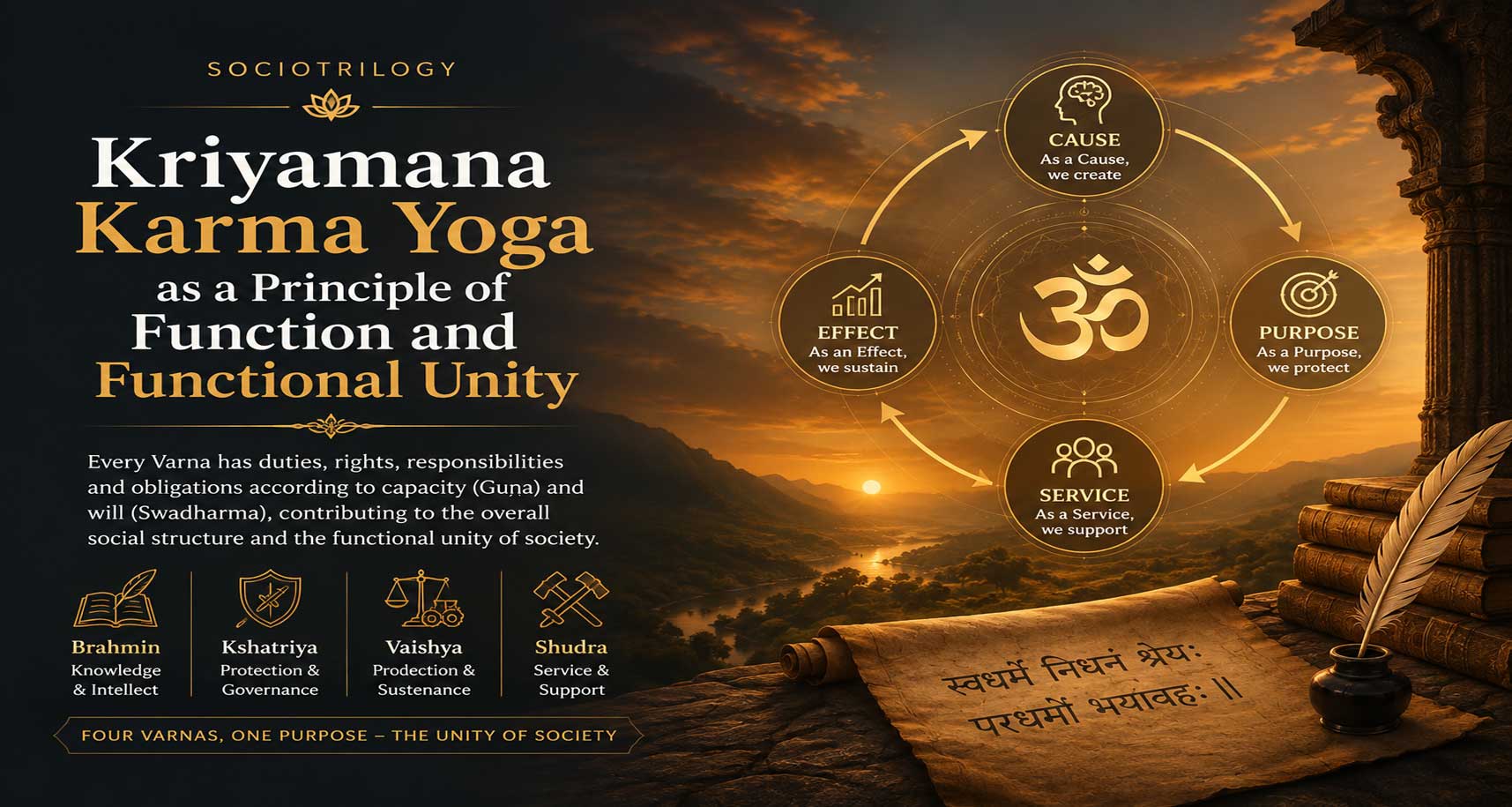
Kriyamana Karma Yoga
Presented as a social functional unity within the conceptual framework.
Samudra Manthan
Presented as a conflict theory and inclusive system of governance.
Social Unity
The perspectives collectively examine society as an interconnected system.
Meaning & Definition of Varna
The Varna System refers to a social structure in which four distinct social or occupational classes, called Varnas, are arranged according to their respective statuses and roles.
This arrangement organizes human interaction and shapes the social behavior of both Varnas and individuals within society.
“Varna” is an ancient Sanskrit term meaning “class” and is associated with Guna, quality, aptitude and tendency.
Brahmin
Intellectual, knowledge-oriented and brilliant functions within society.
Kshatriya
Government, governance, protection and legislative functions.
Vaishya
Agriculture, trade, business, medicine, teaching and judicial functions.
Shudra
Ancillary labour and skilled, semi-skilled and unskilled functions.
The source describes Varna as being based on “Guna and Karma” rather than birth, and presents it as an occupational class within the Varna System.
Varna System as a Horizontal Division of Society
The Varna System is described as a fourfold horizontal division of society in which status and roles are determined by Guna and Karma.
Horizontal division represents the equitable distribution and sharing of power among the principal Varnas.
Brahmin / Intellectual
Intellectual executives and knowledge oriented functions.
Kshatriya / Government
Government, political representation, protection and legislation.
Vaishya
Traders, farmers, merchants, judiciary and medical fraternity.
Shudra / Ancillary
Supports the other three Varnas in performing their primary functions.
Separation of Powers
Each division possesses a distinct sphere of duties, rights and obligations of Swadharma.
Swadharma & Paradharma
Swadharma and Paradharma are presented as fundamental principles of the Varna System and as checks and balances within the separation of powers.
Swadharma
Swadharma means “one’s own Dharma” — duties, rights and obligations aligned with an individual’s nature, talents and skills.
- One's own duties
- Rights and obligations
- Natural talents
- Skills and ability
- Choice of occupation
Paradharma
Paradharma refers to Dharma that does not fall within one's jurisdictional authority.
- Outside one's jurisdiction
- Contrast to Swadharma
- Maintains boundaries
- Supports checks and balances
Swadharma and Paradharma operate as checks and balances that maintain the power structure of the Varna System.
Structure and Functional Unity
The concepts of structure and functional unity are complementary in nature and are presented as essential to understanding human society.
Sociotrilogy compares social structure and functional unity with the organic structure and functional unity of living organisms.
Society as a Living Organism
Every person is considered a basic unit of life and a building block of the whole living society.
Structure
Society consists of orderly arranged and interrelated parts called Varnas.
Function
Every individual and Varna performs particular functions within social life.
Unity
Interrelated functions maintain the continuity and stability of society.
The source explains that functional unity depends on structure, while continuity of structure depends on functional unity.
Divisions Based on Function & Purpose
Social structure is presented as consisting of four divisions, each having a distinct function and purpose directed toward maintaining the existence of human society.
Brahmin / Intelligence
Generates knowledge and contributes to education, research, language, literature, institutions and social reform.
Kshatriya
Coordinates, regulates and governs the functions of the four Varna organs.
Vaishya
Includes farmers, traders, doctors, teachers, businesspeople and members of the judicial fraternity.
Shudra
Provides essential labour and skilled, semi-skilled and unskilled support to the other Varna organs.
Every person and each Varna has a particular function called Varna Dharma.
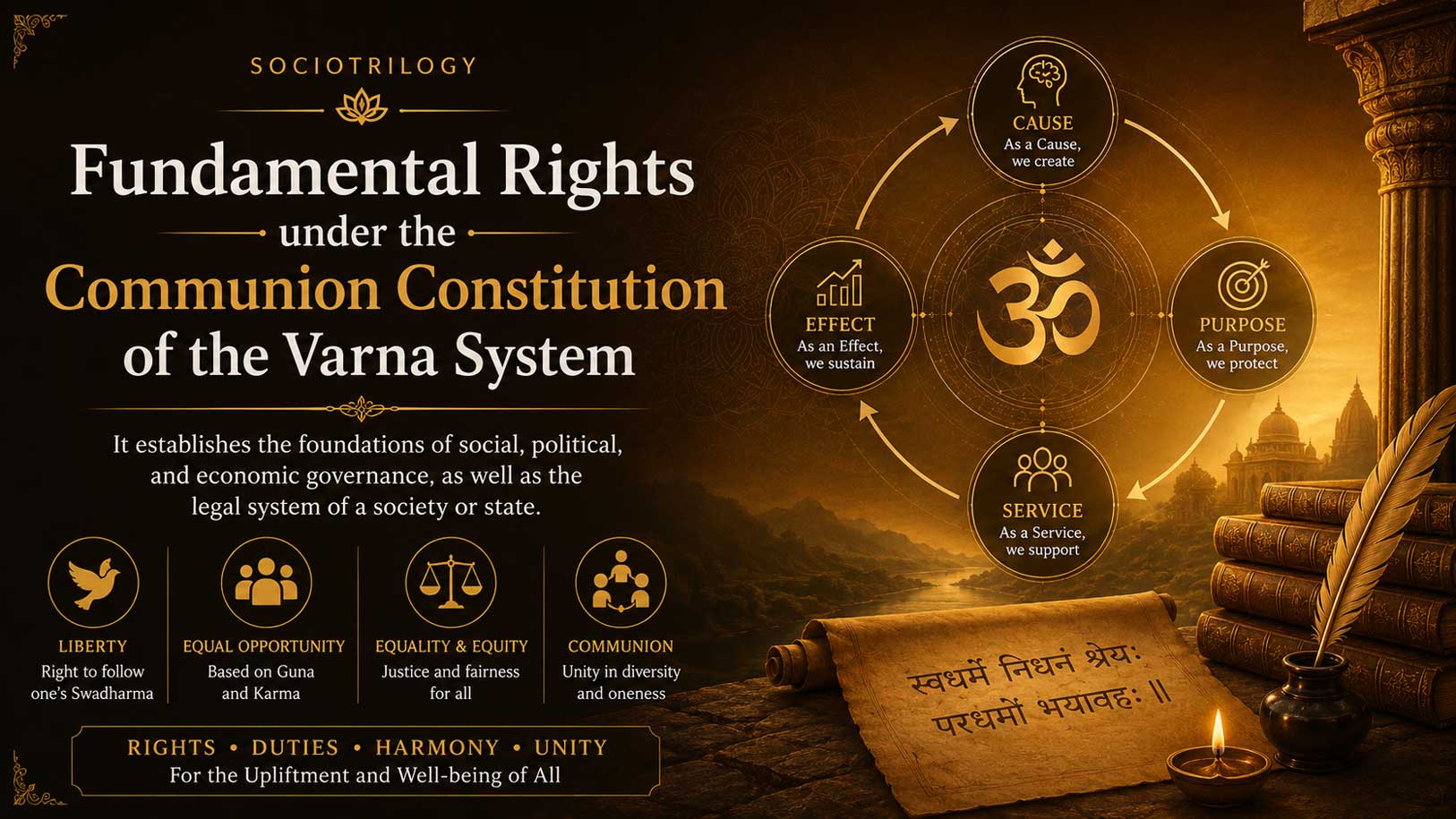
Dharma as a Mechanism of Social Governance
It provides a moral, ethical and legal framework of duties, rights and obligations that upholds and sustains the order of the social system.
From a Sociotrilogical perspective, Dharma is both a mechanism of reciprocal interaction and a framework of duties, rights and obligations.
Duties
Moral and legal responsibilities that individuals are expected to fulfil.
Rights
Legitimate expectations and entitlements within reciprocal relationships.
Law
Compliance with the rule of law gives legitimacy to reciprocal interaction.
Norms of Social Morality
Honesty
Truthfulness, trustworthiness and avoidance of exploitation.
Respect
Respect for elders, teachers and vulnerable people.
Empathy
Compassion, charity and assistance to people in need.
Tolerance & Inclusion
Unity in diversity and opposition to discrimination.
Dynamics and Continuous Interplay of Triguna
In Sanskrit, Guna may be translated as quality, attribute or strand. The gunas are described as modes of nature that constitute the universe, social system, physical reality and human psychology.
Sattva Guna
Represents clarity, balance, peace, harmony, creativity, intelligence and brilliance.
Rajas Guna
Represents passion, activity, movement, dynamism, leadership and governance.
Tamas Guna
Represents inertia, resistance, heaviness, rest and continuity.
All three gunas are continuously present in all things and beings throughout the cosmos in varying proportions.
Their interplay determines characteristics of physical and psychological configurations, energy, forces and matter.
Sattva Dominance
Dominance of Sattva produces inclinations toward creative and intellectual work.
- Knowledge
- Creativity
- Innovation
- Peace
- Harmony
Rajas Dominance
Dominance of Rajas produces qualities of action, governance and dynamism.
- Leadership
- Activity
- Strength
- Governance
- Protection
Dynamic Continuity of Triguna
Sattva, Rajas and Tamas continuously interact and shape the dynamic character of existence.
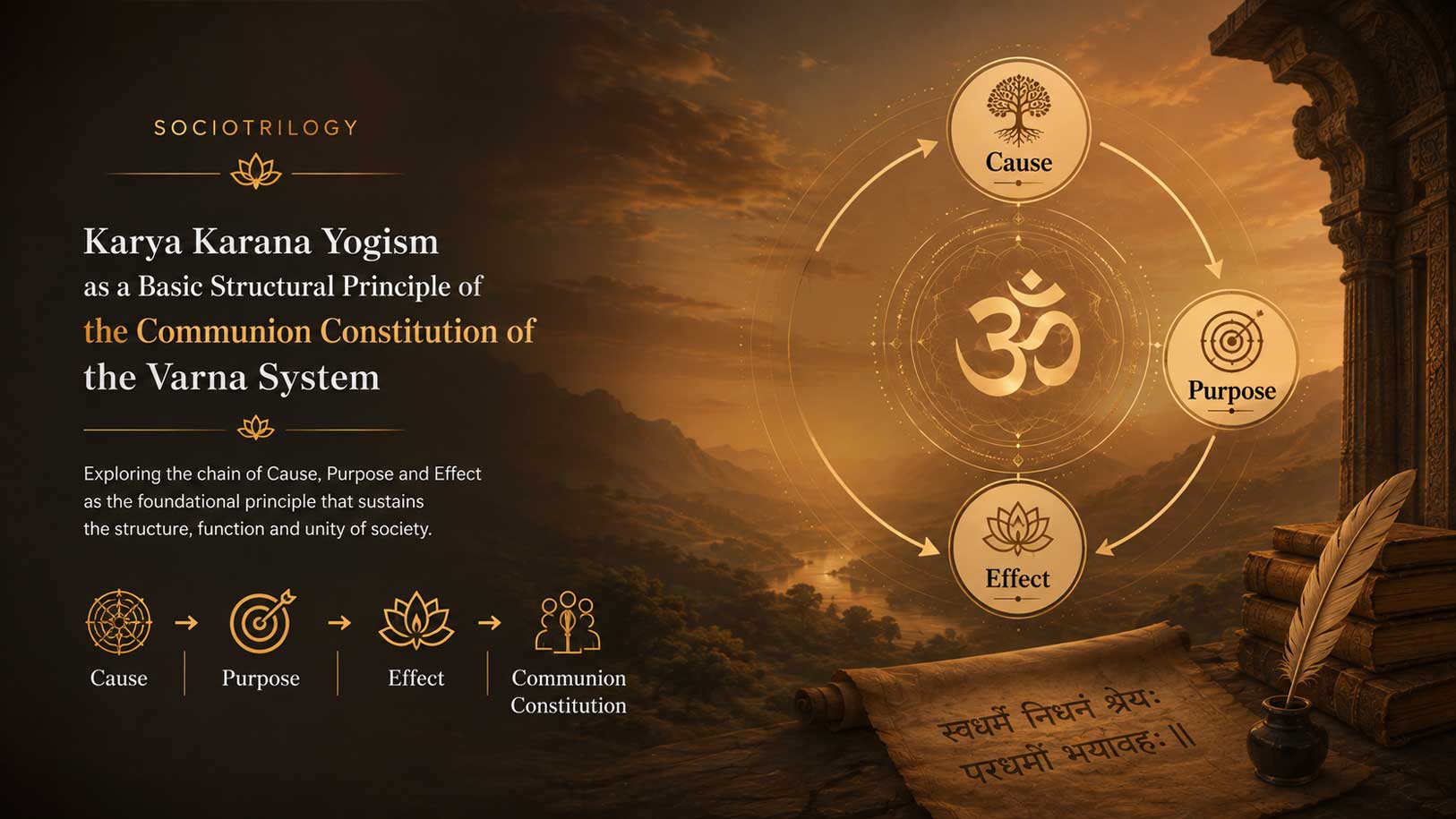
Karya Karana Yogism as a Structural Principle
It forms a continuous sequence of events in which an initial action begins the sequence and produces a corresponding purpose and effect.
Cause
The initial action that begins the sequence.
Purpose
The changed condition or circumstance produced through the process.
Effect
The resulting dimension that can become a new cause.
Unending Propagation
There is no endpoint in the continuous operational loop of the cause–purpose–effect chain.
Real-World Examples
Studying
Studying can lead to better grades, acquired knowledge, employment opportunities and occupational growth.
Saving
Saving can produce financial stability, improved living standards and well-being.
Scientific Research
Research can lead to a cure, achievement in medical science, improved health and service to society.
Multiple Outcomes
A single event may produce multiple effects and changed conditions.
Every event, thing or being may be understood as a point that is itself a cause, an effect and a purpose.
Society as a Functional Unity
The conceptual perspectives of Sociotrilogy bring together social structure, functional unity, Dharma, Triguna and Karya Karana Yogism within a holistic understanding of living society.