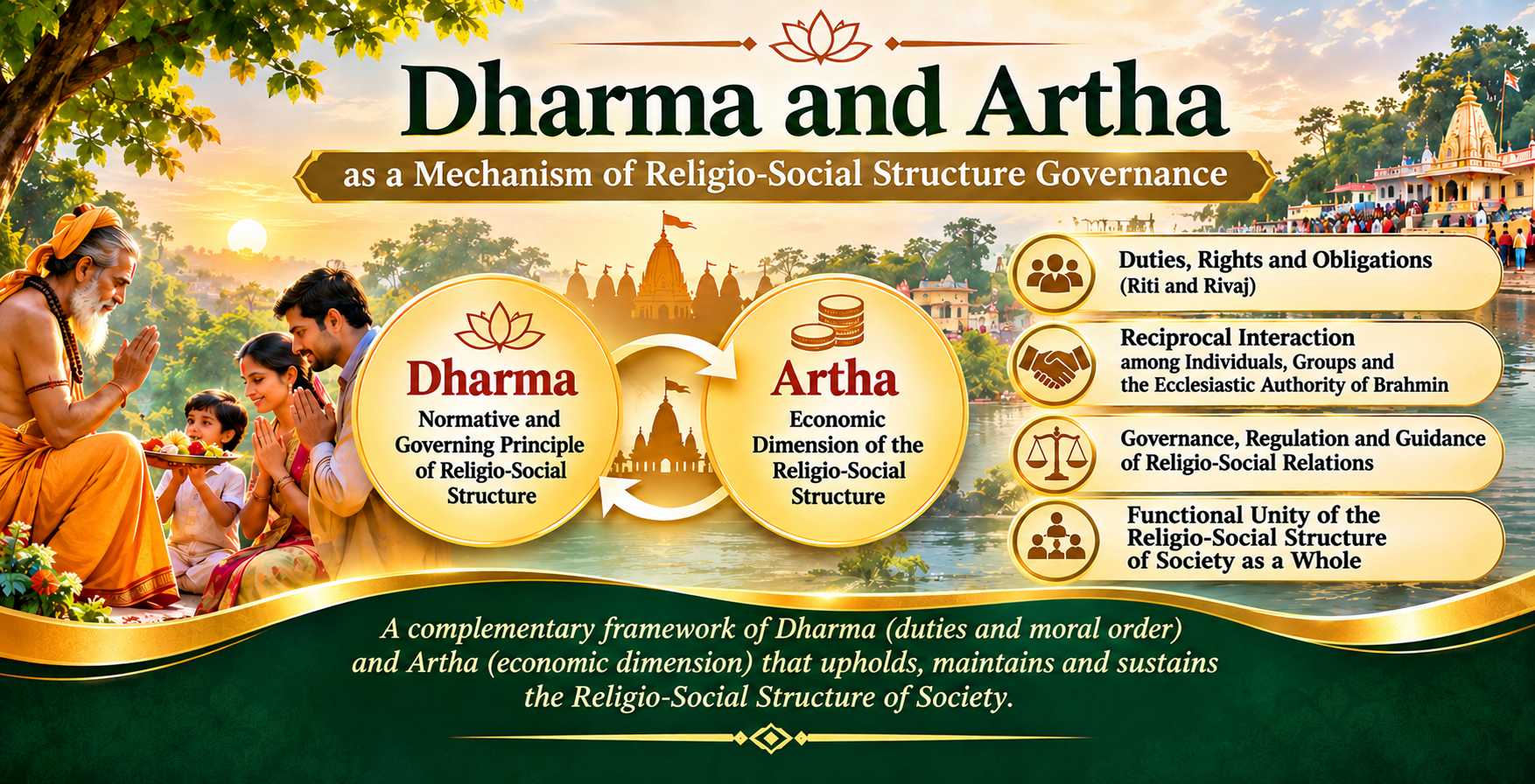
Dharma constitutes the normative and governing principle of Religio-Social Structure of Varna System. It provides a devotional framework of Religio-Social Duties, Rights and obligation to comply with customs and traditions that uphold and sustain the structure of Religio-Social order.
From a Sociotrilogical perspective, Dharma and Artha are both a mechanism of reciprocal interaction and a framework of Duties, Rights and obligation of Customs and Tradition.
Dharma as a Reciprocal Framework
Dharma, as a reciprocal framework, governs, regulates and guides relationships among Individuals, between Individuals and Groups, and among Individuals, Groups and the Ecclesiastic Authority of Brahmin, in accordance with their respective statuses, roles and position.
Religio-Social life and functions operate smoothly when Duties, Rights and Privileges function together as complementary principles, and when participants fulfil their obligations to comply with the norms, rules, customs and traditions governing those Duties, Rights and Privileges, along with Artha: the economic dimension of the Religio-Social Structure.
Dharma and Artha as Reciprocal Mechanisms
Dharma and Artha together constitute a mechanism of reciprocal interaction among people that upholds, maintains and sustains the Religio-Social Order.
The framework of Duties, Rights and reciprocity, together with the obligation to comply with the norms, rules, customs and traditions governing such reciprocity, constitutes the mechanism of Dharma and Artha.
This mechanism upholds, maintains and sustains the Religio-Social Structure of Society.
Artha: The Economic Dimension
The Economic Dimension of the Individual Kriyamana Karma Yoga of the Four Varnas and the Functional Unity of the Religio-Social Structure of Ecclesiastic Authority of the Brahmin Varna, within Society as a Whole.
I. Individual Religio-Social (Dharma) Duties, Rights and Associated Artha Dimension
1. Religio-Social Duties
Religio-Social practices or functions include all the nine forms of devotional functions, going on pilgrimage sites, visiting temples for darshan, receiving purohit, pandit or pujari sacramental services are their Religio-Social Duties.
2. Artha Dimension
Practitioners, devotees and yajmana, in exchange for the sacramental services received, offer Dakshina, Dana or donations as devotional duties to the Ecclesiastic Authority of Brahmin.
II. Religio-Social Duties, Rights and Privileges and Associated Artha of Ecclesiastic Authority of Brahmin
1. Religio-Social Duties
To provide, guarantee or protect the Religio-Social Rights of all the members of the Four Varnas, to grant Dvija status, and to render all the sacramental services are the duties of the Ecclesiastic Authority of Brahmin.
2. Rights and Privileges: Ecclesiastic Authority of Brahmin
The Ecclesiastic Authority of Brahmin accepts devotional offerings, such as Dakshina, Dana or donations, from the members of the Religio-Social Structure as its rights and privileges in governing and managing the affairs of the Religio-Social Structure of Society as a whole.
Dharma and Artha together describe a reciprocal framework through which Duties, Rights, Privileges and economic functions contribute to the continuity and sustenance of the Religio-Social Structure of Society.