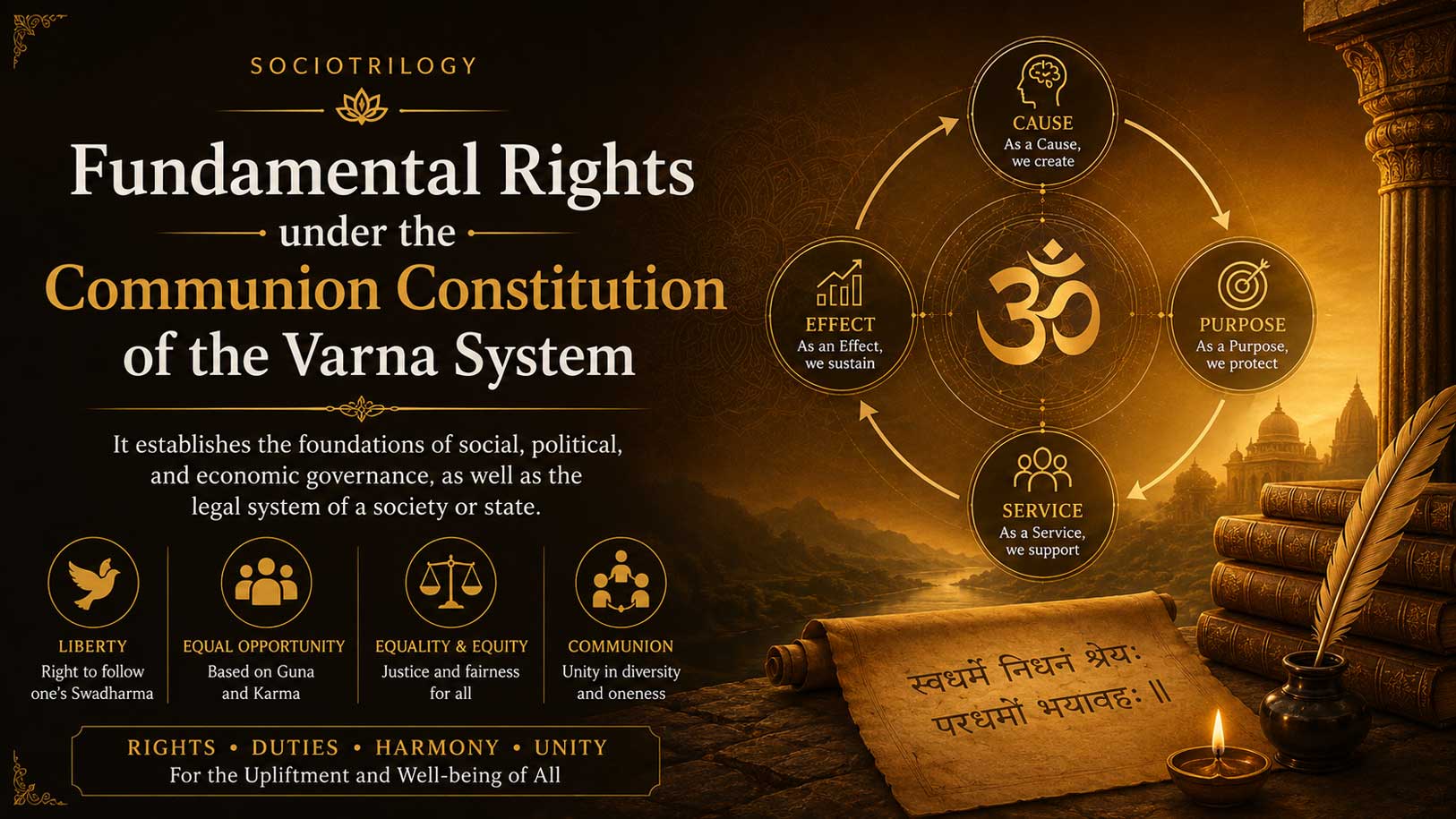
It establishes the foundation of codified legal statues of religio-social structure of society.
The three fundamental rights of religio-social justice of society are:
Swadharma
Right to liberty and the freedom to pursue one's Swadharma.
Guna and Karma
Right to equal opportunity for religio-social justice.
Sarvatmanodaya
Spiritual upliftment of all and the right to religio-social justice.
1. Swadharma — Right to Liberty
Swadharma is a Sanskrit concept. Swa means “self” and Dharma means duties, rights, privileges and obligations to comply with the norms or rules of religio-social structure.
It denotes righteous religio-social living aligned with an individual's varying proportional distribution of Gunas (Sattva, Rajas and Tamas), which shape the individual's natural disposition, merit, worth and inclination towards spiritual life.
It determines the kind of Karma an individual should perform as an occupation or service in religio-social life, thereby promoting individual spiritual well-being while contributing to the continuity of the religio-social order.
Swadharma: A principle connecting an individual's disposition, duties and participation in religio-social life.
Swadharma as a Fundamental Right of Religio-Social Justice: Right to Liberty
Liberty to pursue one's Swadharma is a natural right arising from the human status as a basic unit of life, a building block or as a religio-social being in the formation of religio-social structure of society.
Swadharma empowers each individual with liberty to have access to religio-social membership and opportunities to enrich his religio-social being and worth, without arbitrary restraint, restriction or discrimination.
Religio-social structure as a part of the Communion Constitution of Varna System: “Right to liberty” is a natural fundamental right, a derivative principle of Swadharma.
2. Guna and Karma: Right to Equal Opportunity for Religio-Social Justice
Religio-social structure of society is based on “Guna and Karma,” meaning individual Guna that inclination to spiritual path and his character, and willingness to follow his spiritual or religio-social practices to attain status, position and authority.
As Karma determines his Brahmin Varna rather than by his birth or background to become Purohit, Pandit or Pujari.
Accordingly, the concept presupposes equal opportunity as a principle derived at Guna and Karma.
Equal opportunity refers to open access to religio-social structure for every individual without arbitrary restraint, restriction or obstruction, so that every individual has an equal chance to have equal membership and participation in the religio-social structure; to attain status, position and power of Purohit, Pandit and Pujari; to realise the deeper state of “Tattva Masi.”
“Tattva Masi”
Represents the epitome of human equality, a fountainhead of religio-social structure.
In the Communion Constitution of Varna System, equal opportunity to religio-social structure based on Guna and Karma is a fundamental right to religio-social justice.
3. Sarvatmanodaya (Based on “Ishavasyam Idam Sarvam”): Right to Religio-Social Justice
Sarvatmanodaya means “spiritual upliftment of all” or spiritual progress or spiritual well-being of all.
It is derived from Sarva (“all”) and Atma, the deeper state of physical existence, “Tattva Masi”; Udaya means “spiritual upliftment or spiritual well-being.”
It is built on the following principle: the spiritual upliftment and well-being of all.
1. Right to Equality
Every individual is a basic unit of life and a building block of religio-social structure, possessing the equal right to religio-social life, irrespective of gender, creed, colour, ethnicity, race or region, without any discrimination or prejudice.
- Equal right to religio-social life.
- Equal participation without discrimination or prejudice.
- Recognition of every individual as a basic unit of religio-social structure.
Tattva Masi, as an epitome of equality, provides a basis for every individual. This right of equality contributes to building Sarvatmanodaya.
Right to Communion (Tattva Masi): Unity in Diversity of Oneness
Unity in diversity refers to people from diverse fields, possessing different talents, skills, abilities and capacities, and belonging to different Varnas (occupational classes), cultures, ethnicities, languages and regions, working together to promote harmony, peace and solidarity in human life and in living society, united as a whole.
Oneness and Communion
“Oneness” refers to communion as the fundamental reality of interconnected consciousness. It is a deeper state of religio-social being in which the ego dissolves and transcends into an interconnected bond of ultimate consciousness.
All beings are expressions of the same source of ultimate consciousness. The same creative, maintaining and sustaining spark of life runs through each of us and through everything on the planet. Nothing exists as entirely separate.
Communion
Unity in diversity, interconnected consciousness, harmony, peace and solidarity in living society.
The union of three states of consciousness associated with the Varna System transcends into the fourth state of ultimate consciousness — Communion.
In the Communion Constitution of Varna System, Sarvatmanodaya is the objective resolution or ultimate objective principle of religio-social structure, representing a fundamental right to religio-social justice.