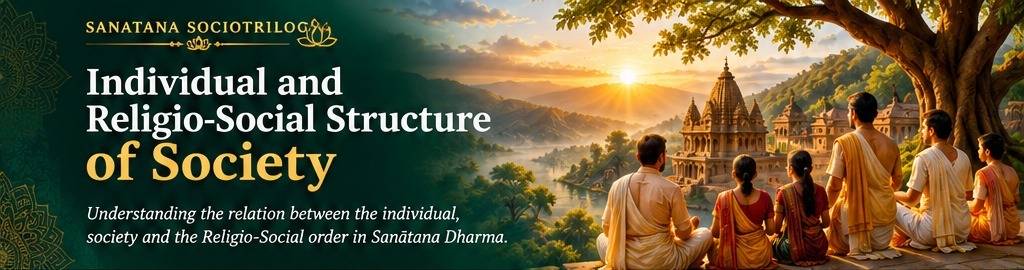
Man is a religio-social being. The deeper state of religio-social being is Tattva Masi.
The relationship between the individual and the religio-social structure of living society is a central concern of Sociotrilogy. It explores how individuals belong to society, depend upon it, and contribute to its existence.
Individual and Religio-Social Structure of Society
Man is a religio-social being; the deeper state of religio-social being is Tattva masi.
He lives in groups or communities in religio-social structure of society.
Man is biologically and psychologically, as a religio-social being, equipped to live in groups and build a religio-social structure of society. It becomes an essential condition for human life to arise and grow as a religio-social being.
There is a vast literature of Vedas, Upanishads, Vedanta, a host of Puranas and Gita, and Bhagavad Gita on the question of such as, the nature or essence of man's religio-social life, its origin and source.
It is essential to study the deepest question that exists between the individual and religio-social structure of living society.
Religio-Sociality and Religio-Sociability of Man: Central Problem of Sociotrilogy
Man is a religio-social being. This proposition gives room to the central problem of Sociotrilogy, i.e. religio-sociality or religio-sociability of man.
The essential fact is that man has always been a religio-social being and belongs to the religio-social structure of society. Without this, the religio-social aspect of his nature cannot exist. Several questions of great sociotrilogical importance arise in this regard.
Fundamental Questions of Sociotrilogy
Questions at the heart of Sociotrilogy
In what sense is man a religio-social being? In what sense does the religio-social structure of society belong to us? What is the nature of our dependency upon it and its dependency on us?
These questions take us to the fundamental question of the relationship between the individual and religio-social structure of society.
The relationship between individual and religio-social structure of society is intimately one of the most profound of all the problems of Sociotrilogy, because it involves the question of intrinsic value [love, harmony, inner peace, stability, and tranquillity].
Since the time immemorial, man wondered if my body, mind and brain belonged to me, who created it? And who am I? So to find the answer to these questions he came to believe that there is so much creation around me, and I am a part of it, then there must be a creator.
In search of who I am, his instinct quest to know the truth.Through Dhyana Yoga and Gyana Yoga, he found himself as tatva masi, which means “I am that,” I am from within an ultimate state of consciousness: Tattva Masi is the source of religio-social being.
We as a religio-social being seek ourselves and the society on the other side, the person and the group, an individual and collectivity. What does each individual as well as a religio-social being owe to others. In this quest of truth, he formed the religio-social structure of society.
Hence every individual as a religio-social being is a part of the religio-social structure that is greater than he, and religio-social structure exists for individuals.
The religio-social structure belongs to him and an individual as a basic unit of life or a building block belongs to the religio-social structure.
Man Depends on Religio-Social Structure of Society
It is a thing of common observation for everyone that individuals are engaged in puja, bhajan, kirtan, pray to God, sadhana, aarti, temple visit and pilgrimage site, do yoga and meditation and so on.
With millions like him in society, it is in the society that individuals are surrounded or encompassed by religio-social culture or a religio-social force.
It is obvious that man has a capacity for religio-social life but also an intrinsic need for it — to realise Tattva Masi, to achieve inner peace, harmony and tranquillity.
It is in the religio-social structure of society, as a religio-social being, has to conform to norms and values prescribed for every status, position and authority to exercise his duties, rights and obligations of norms (Dharma) by being a member of the religio-social structure of society.
Religio-social structure represents a part of “Purush,” described in Purush Sukta of ancient Rigveda.
The “Purush” in immanent form represents the total organismic structure of human society.
No human being can develop and grow spiritually in religio-social isolation. Every individual depends upon the religio-social structure of society to explore his religio-social being, to realise his real self.
‘Tattva Masi’
Conscious Experience of Communion
Religio-Social Structure Depends on Individuals
Every individual as a religio-social being is a basic unit of life and a building block of religio-social structure of society, function and part of the functional unity of the religio-social aspect of society.
Religio-social structure is an inclusive system of humankind; its total life processes depend on every unit of human life to find its complete existence.
The total life processes of religio-social structure of the social organism of society involve the sum total of all the individuals of the four Varnas, their membership and equal participation to attain Sarvatmanodaya in the life processes of religio-social structure, in the form of functional unity of society as a larger organism.
Religio-social structure of society enables the individual to explore his religio-social being and enables psychological development of religio-social consciousness and religio-sociability.
The biological potential of becoming religio-social is inherent in the very nature of man.