Kriyamana Karma Yoga (Functional Principle of the Varna System)
INTRODUCTION Kriyamana Karma Yoga (Functional Principle of the Varna System) Kriyamāṇa Karma means the actions performed in one’s present life through the exercise of free will. Free Will These are the actions in which one engages through thoughts, words, and deeds, including everyday routine work, professional activities, occupational duties, responsibilities, and obligations. Shaping the Future Present actions may produce immediate results or yield results in the future. For example, bathing brings freshness, while sustained hard work may lead to success in life. Power of Change Kriyamāṇa Karma is fully under one’s control and operates on the basis of Kriyā Kāraṇa (cause and effect). For example, engaging successfully in business may create wealth, while diligent study may enable a person to become a renowned scholar. The orientation of Kriyamāṇa Karma Yoga is towards serving the lives of others alongside one’s own life; the results of action are regarded as natural consequences. DEFINITION Definition of Kriyamana Karma Yoga Kriyamāṇa Karma Yoga refers to the performance of duties and responsibilities with complete dedication and commitment, without selfish motive, for the purpose of serving human life and human society, and without attachment to a possessive obsession with results, rewards, wealth, material achievements, name, fame, glamour, or success. CHARACTERISTICS Significant Characteristics of Kriyamana Karma Yoga 01 Purpose-Oriented Actions are purpose-driven and focus on serving human life. They emphasize a meaningful relationship between work, responsibility, and contribution to society. 02 Dharma as a Governing Principle Dharma provides a framework of duties, rights, legal obligations, rules, regulations, and codes of conduct related to every action. 03 Detachment from Material Achievement The central principle of Kriyamāṇa Karma Yoga is freedom from possessive obsession with wealth, status, power, achievements, and material success. 04 The Performer Is an Instrument The performer is merely an instrument who uses intellectual and natural resources as causes to produce effects that serve human life. EXAMPLES Examples of Kriyamana Karma Yoga EXAMPLE 01 Writer A writer uses intellect and talent as a cause to write a book on the economy of the country. The book becomes the effect, while enriching people’s lives through knowledge becomes the purpose. EXAMPLE 02 Farmer A farmer uses land, soil, water, urea, and the mind as causes to cultivate crops. Food grains become the effect, while sustaining human life becomes the purpose.
Samudra Manthan Conflict Theory
SOCIOTRILOLOGY • CONFLICT THEORY Samudra Manthan Conflict Theory A Sociotrilogical framework examining the role of conflict within the social structure and relationships of the Varna system. It is a Sociotrilogical framework that examines the role of conflict within the social structure and relationships of the Varna system. 01 — CONCEPTUAL FOUNDATION Meaning of Samudra Manthan ≋ Meaning of Samudra “Ocean” Samudra is a Sanskrit word meaning “ocean.” In the study of Sociotrilogy, Samudra Manthan refers to national and natural resources, opportunities, wealth, land, status, roles, and power. ⟳ Meaning of Manthan “Churning” Manthan literally means “churning.” Metaphorically, it describes deep contemplation and the process of thoroughly analysing conflicts and related problems. It involves sustained mental reflection, or the “churning of the mind,” to derive valuable insights and solutions to conflict. 02 — CORE THEORY Samudra Manthan Conflict Theory ॐ Society in a Constant State of Conflict Samudra Manthan conflict theory states that society exists in a constant state of conflict. This condition arises because groups and individuals compete for limited resources, such as money, power, land, and material and natural resources. People with wealth and power may misuse rules and social systems to exercise control and domination. 03 — SOCIAL GROUPS The Two Groups within Conflict Samudra Manthan conflict theory divides society into two groups. GROUP 01 Wealth and Power Rich people and groups possessing power, status, group identity, and political and economic influence. GROUP 02 Oppressed and Exploited Groups Poor people and groups who are socially, economically, and politically oppressed, exploited, and discriminated against on the basis of gender, race, language, and region. 04 — KEY IDEAS Key Ideas of Conflict Theory 01 Scarcity of Resources Money, land, food, housing, and natural resources are limited, whereas demands are unlimited. 02 Power Struggle Social order is maintained not by force or power, but through Samudra Manthan. 03 Upliftment of All Samudra Manthan is the means through which society promotes the well-being, growth, and development of all. 04 Inclusive System of Governance The framework is based on Swadharma, Guna and Karma, and Sarvodaya. 05 — GOVERNANCE Inclusive System of Governance Three Foundational Principles The inclusive system of governance is based on the following principles: PRINCIPLE 01 Swadharma PRINCIPLE 02 Guna and Karma PRINCIPLE 03 Sarvodaya ॐ From Conflict to Collective Well-Being Samudra Manthan represents the process of analysing conflicts and related problems through sustained contemplation to derive valuable insights and solutions, ultimately promoting the well-being, growth, and development of all.
Fundamental Rights under the Communion Constitution of the Varna System
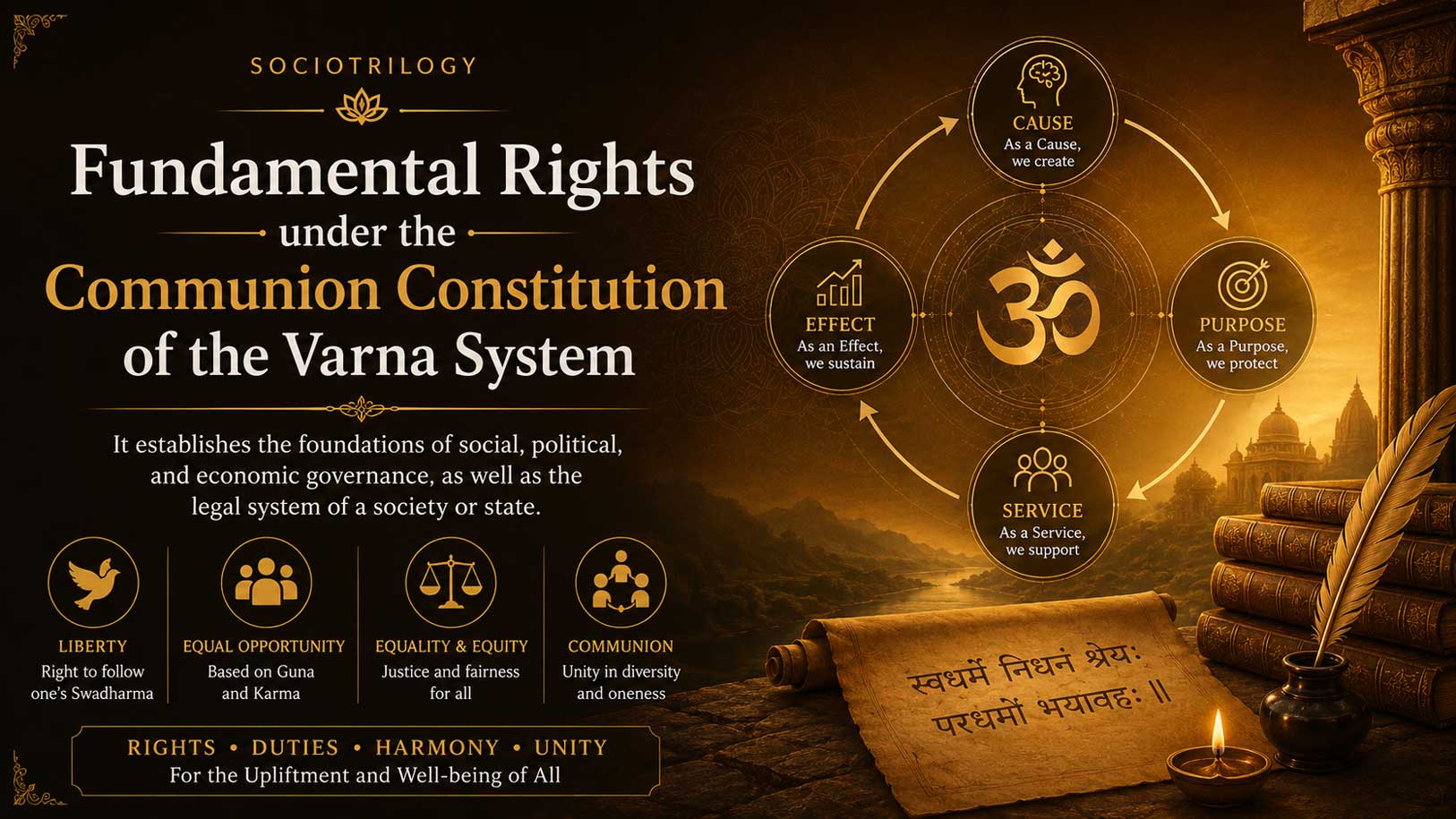
SOCIOTRILOGY • COMMUNION CONSTITUTION Fundamental Rights under the Communion Constitution of the Varna System The foundational principles of liberty, equal opportunity, equality, equity, and communion within the social, political, economic, and legal framework of society. The Communion Constitution of the Varna System establishes the foundations of social, political, and economic governance, as well as the legal system of a society or state. The Three fundamental rights are Swadharma, Guna and Karma and Sarvodaya. The Three Fundamental Rights 01 Swadharma Right to Liberty Liberty to pursue one’s Swadharma according to natural disposition, talent, merit, rights and obligations. 02 Guna and Karma Right to Equal Opportunity Equal opportunity based on qualities, talents, skills and effort rather than birth or background. 03 Sarvodaya Upliftment of All The progress, equality, equity, unity in diversity and well-being of all individuals. 01 — FUNDAMENTAL RIGHT Swadharma — Right to Liberty Swadharma is a Sanskrit concept. ‘Swa’ means ‘self,’ and ‘Dharma’ means ‘duties, rights, and obligations.’ It denotes righteous living aligned with an individual’s proportional distribution of the Gunas (Sattva, Rajas, and Tamas), which shapes that individual’s natural disposition, talent, and merit. It determines the kind of Karma an individual should perform as an occupation in life, thereby promoting individual well-being while contributing to the continuity of the social order. 01 Swadharma as a Fundamental Right Liberty to pursue one’s Swadharma is a natural right arising from the human being’s status as a basic unit of life within society. Liberty to Pursue Swadharma Swadharma empowers each individual with the liberty to access opportunities that enrich their talent, merit, and worth, without arbitrary restraint, restriction, or discrimination. Fundamental Principle: In the Communion Constitution of the Varna System, liberty is a natural fundamental right and a derivative principle of Swadharma. 02 — FUNDAMENTAL RIGHT Guna and Karma — Right to Equal Opportunity The four occupational categories of the Varna System are based on “Guna and Karma,” meaning that they are determined according to an individual’s qualities and talents. Guna Guna refers to the qualities, characteristics and talents that shape an individual’s natural disposition. Karma Karma refers to the activities in which an individual engages in accordance with their Swadharma. Guna and Karma are closely connected with meritocracy. Under this principle, success is determined by talent, skills, and effort (Karma), rather than by birth or background. Equal Opportunity Equal opportunity refers to open access to educational, social, political, and economic opportunities without arbitrary restraint, restriction, or obstruction. Every individual should have an equal chance to succeed according to their Swadharma. 02 Right to Equal Opportunity Equal opportunity based on “Guna and Karma” is a fundamental right of every individual. 03 — FUNDAMENTAL RIGHT Sarvodaya — Upliftment of All Sarvodaya means the “upliftment of all” or the “progress and well-being of all.” It is derived from Sarva (“all”) and Udaya (“uplift” or “well-being”). It is based on the following principles: PRINCIPLE 01 Right to Equality Every individual being is a basic unit of life and a building block of the social organism of society. Every unit of life possesses the same right to life, irrespective of gender, creed, colour, ethnicity, region, or any other distinction. PRINCIPLE 02 Right to Equity Equity involves allocating resources and opportunities in varying measure according to individual needs, circumstances, or systemic disadvantages. The purpose is to ensure that everyone has a fair chance to succeed and that inclusive growth and development can be ensured. PRINCIPLE 03 Right to Communion Unity in diversity refers to people from diverse fields, possessing different talents, skills, abilities, and capacities, working together. Their cooperation promotes harmony, peace, solidarity and unity in human life and society. ॐ Unity in Diversity and Oneness “Oneness” refers to communion. Communion is the fundamental reality of interconnected consciousness. It is a deeper state of being in which the ego dissolves and a transcendent, interconnected bond of ultimate consciousness is realized. All beings are expressions of the same source of ultimate consciousness. The same creative, maintaining, and sustaining spark of life runs through each of us and through everything on the planet; nothing exists as entirely separate. 04 — CONSCIOUSNESS Ātman Equals Brahman — Consciousness Constitutes Communion Every individual consciousness consists of four states of consciousness: 01 Jāgrat Avasthā Waking Consciousness 02 Svapna Avasthā Dreaming Consciousness 03 Suṣupti Avasthā Deep-Sleep State of Consciousness 04 Ultimate Consciousness Brahman or Turīya The Conscious Observer The mind, brain, and eyes, together with their coordination, are merely instruments of measurement within the power of illusion of ultimate consciousness (Brahman), the conscious observer. The Four States and Communion The union of the three states of consciousness associated with the physical world transcends into the fourth state of ultimate consciousness— communion. Communion is the fundamental reality in which the three conscious states of cosmic existence are united within a transcendent, interconnected, ultimate state of consciousness. ॐ Consciousness Constitutes Communion The three conscious states of cosmic existence are united within a transcendent, interconnected and ultimate state of consciousness — communion.
Kriyamana Karma Yoga as a Principle of Function and Functional Unity
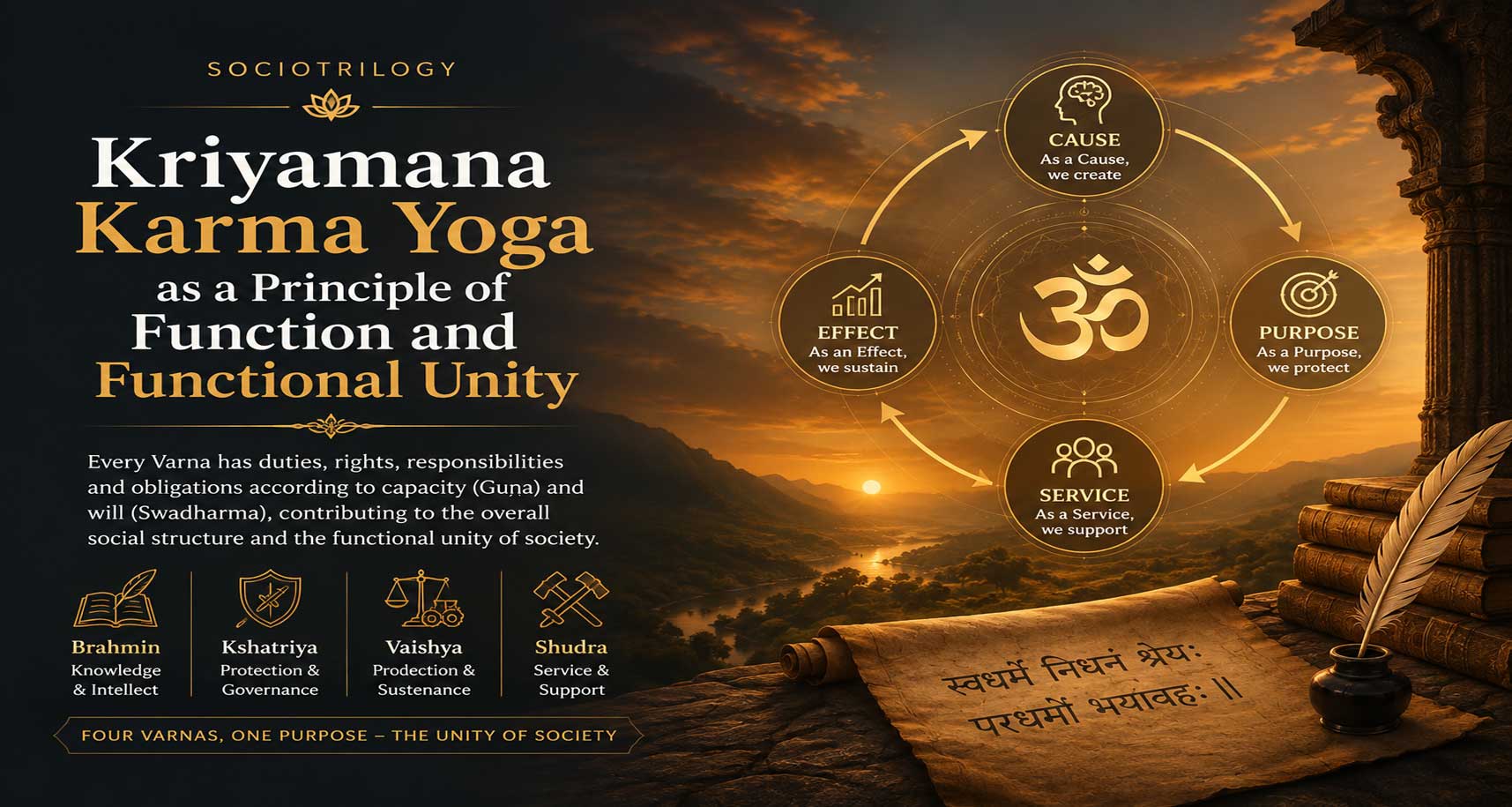
SOCIOTRILOGY • FUNCTIONAL UNITY Kriyamana Karma Yoga as a Principle of Function and Functional Unity Every Varna has duties, rights, responsibilities and obligations according to capacity (Guṇa) and will (Swadharma), contributing to the overall social structure and functional unity of society. The four forms of Kriyamāṇa Karma Yoga— Brahmin, Kshatriya, Vaishya and Śūdra— are interrelated and interdependent. Their interactional functions together constitute the functional unity of the social structure. 01 Brahmin Knowledge, intellect, reasoning, science and innovation. 02 Kshatriya Governance, maintenance, preservation and protection. 03 Vaishya Production of goods, services and sustaining human life. 04 Shudra Ancillary services, skilled, semi-skilled and unskilled work. 01 — THE FOUR VARNAS Kriyamana Karma Yoga of the Four Varnas In Kriyamāṇa Karma Yoga, the performer, or “person in action,” is merely an “instrument” of Karya Karana Yogism. The performer uses intellectual capacity (Guna), material resources or natural resources as a “cause” and brings about results that serve human life. Through this function, the performer contributes to the maintenance and functional development of society. Cause → purpose → Effect CAUSE Capacity, Guna, Material & Natural Resources ↓ Purpose Product knowledge and good service ↓ EFFECT Results that serve human life 02 — BRAHMIN / INTELLECTUAL VARNA Individual Kriyamana Karma Yoga of Brahmin Varna A person of the Brahmin/Intellectual Varna uses intellectual characteristics and personal traits such as thinking, learning, reasoning, open-mindedness, curiosity and intellectual humility as causes in the performance of action. CAUSE Intellectual Capacity Thinking, learning, reasoning, curiosity and intellectual humility. FUNCTION Knowledge Creation Language, literature, science, discovery, innovation and technology. PURPOSE Enrich Human Life Enrichment of human life through knowledge, research and development. 03 — KSHATRIYA VARNA Individual Kriyamana Karma Yoga of Kshatriya Varna A person of the Kshatriya Varna uses political institutions, organizations, associations and constitutional duties as part of the functional structure. Maintaining, preserving and protecting the social structure from destruction of social order is the principal purpose function of Kshatriya Varna. 04 — VAISHYA VARNA Individual Kriyamana Karma Yoga of Vaishya Varna A person of the Vaishya Varna contributes to sustaining human life and the life of society through the production of goods, products and services. EXAMPLE 01 Farmers Farmers cultivate crops, raise livestock and produce raw materials that help sustain human life. EXAMPLE 02 Manufacturers Manufacturers use raw materials, machinery, labour and resources to produce finished goods. EXAMPLE 03 Traders & Merchants Traders and merchants connect producers with consumers through buying and selling goods. EXAMPLE 04 Doctors & Medical Fraternity Doctors apply medical knowledge to diagnose and treat patients, contributing to human health. EXAMPLE 05 Judiciary The judiciary protects fundamental rights and helps maintain the social structure. 05 — SHUDRA VARNA Individual Kriyamana Karma Yoga of Shudra Varna A person of the Shudra Varna applies skills and specialized abilities in Kriyamana Karma Yoga as a cause. Artisans, labourers and other ancillary service providers contribute through necessary services that support the maintenance and sustenance of society. 06 — FUNCTIONAL UNITY Functional Unity of Social Structure The four forms of Kriyamana Karma Yoga are interrelated and interdependent. Their programmed interactional functions together constitute the functional unity of the social structure. Economic Dimension of Interaction An effect propagates by becoming a cause that triggers a new effect and a new purpose. Through this interaction, the effect dimension of each Varna becomes a cause that contributes to a new effect and purpose, enabling functional unity. 07 — ECONOMIC INTERACTION The Four Varnas in Functional Interaction 01 Brahmin Knowledge production and transmission. Effect: Income and recognition. Purpose: Enrich human life through knowledge. 02 Kshatriya Governance and protection of social order. Effect: Government revenue. Purpose: Growth and development. 03 Vaishya Production of goods and services. Effect: Goods, services and income. Purpose: Sustaining human life. 04 Shudra Ancillary services and necessary work. Effect: Income and remuneration. Purpose: Supporting livelihood. ॐ Kriyamana Karma Yoga & Functional Unity The interaction of the four Kriyamana Karmas creates functional unity within the social structure.
Karya Karana Yogism as a Basic Structural Principle of the Communion Constitution of the Varna System
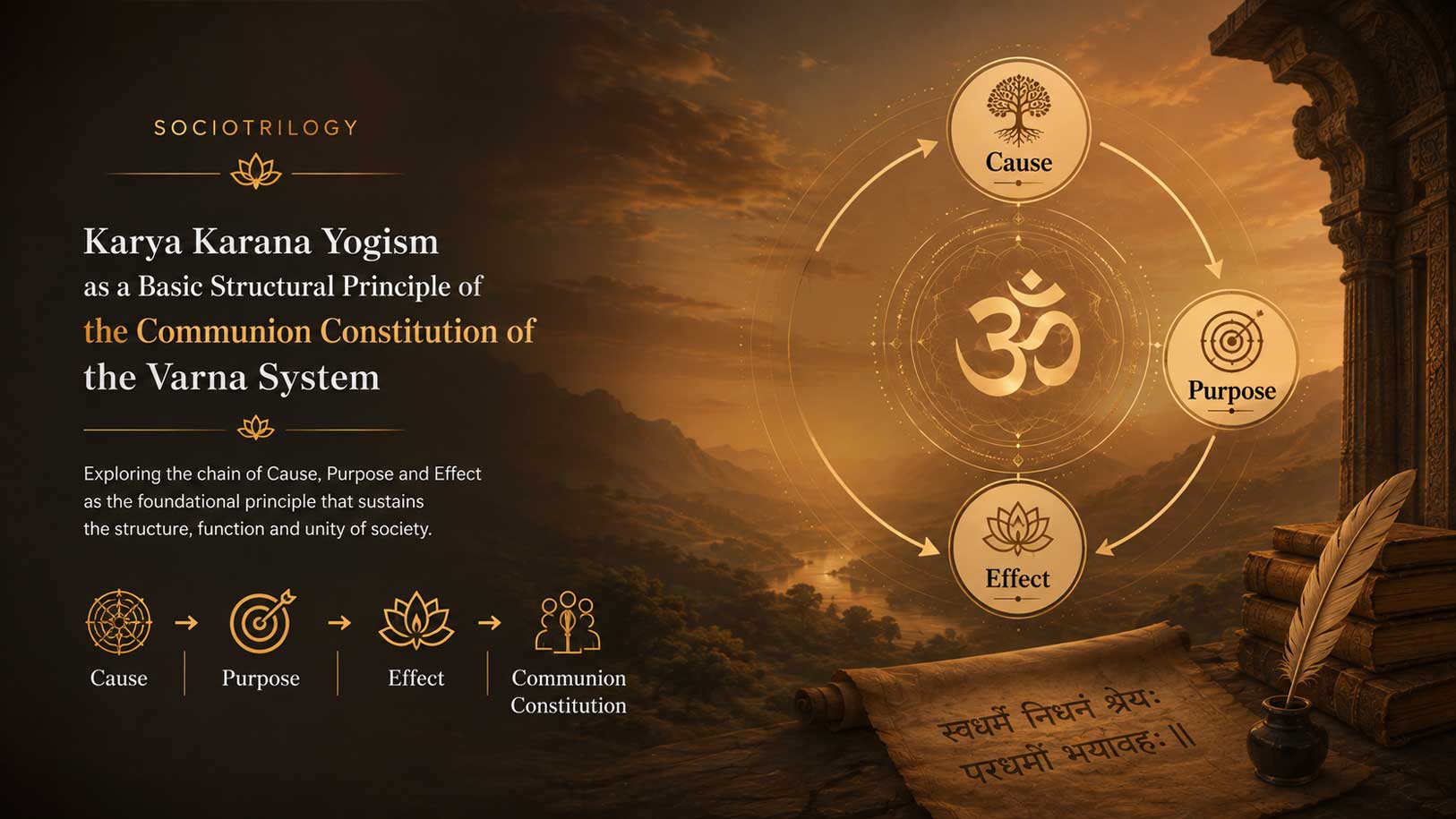
SOCIOTRILOGY • RESEARCH ARTICLE Karya Karana Yogism as a Basic Structural Principle of the Communion Constitution of the Varna System Karya Karana Yogism presents a structural framework of cause, purpose, and effect relationships within the Communion Constitution of the Varna System. 01 Cause Brahmin Varna Intelligent Cause — Nimitta Karana. 02 Purpose Kshatriya Varna To maintain, preserve and protect the social structure. 03 Effect Vaishya Varna Sustaining the social structure and enabling its dynamic continuity. 01 — THE FOUNDATION Karya Karana Yogism Karya Karana is a philosophical concept found in the Upanishadic texts. It regards reason and purpose as primary sources and tests of knowledge, thereby prioritizing logic, intellect, thought, internal coherence, and innate concepts. Karya Karana Yogism is a firmly established framework of cause-purpose-effect relationships. As a structural principle of the Varna System, it comprises three structural elements—cause, purpose, and effect. Karya Karana Yogism serves as a structural principle and forms the backbone of the Varna System. The first three Varnas respectively represent the cause, purpose, and effect dimensions of Karya Karana Yogism. The fourth Varna is an inseparable and integral part of these three Varnas. Relationship of Cause, Purpose and Effect CAUSE BrahminVarna → PURPOSE KshatriyaVarna → EFFECT VaishyaVarna Shudra Varna Inseparable and Integral Part of All Three 02 — THE SOCIAL STRUCTURE Varna System as the Communion Constitution The Varna System, as a constitution of communion, is the union of three conscious states of living society. The horizontal division of the fourfold Varna System forms the social organism of the communion constitution. ◉ Intelligent Cause Nimitta Karana — Brahmin Varna shapes the form and structure of the social system. ♢ Purpose Kshatriya Varna maintains, preserves and protects the social structure. ⌁ Effect Dimension Vaishya Varna sustains the social structure and enables dynamic continuity. ♧ Fourth Varna Shudra Varna is an inseparable and integral part of all cause-purpose-effect dimensions. 03 — INTELLIGENT CAUSE Brahmin / Intelligent Varna Within Karya Karana Yogism as a fundamental structural principle, Brahmin Varna is understood as the causal dimension (Nimitta Karana) of the Varna System. At the level of social structure, this intelligent force shapes and directs the creation of the social structure and therefore constitutes the cause dimension. The Brahmin/Intelligent Varna is driven by a dominant state of Sattva Guna. The “A” sound and the lower curve of the Devanagari symbol ॐ represent the conscious state of Brahmin Varna. Brahmin / Intelligent Varna Brahmin / Intelligent Varna Brahmin, Sant, Maharishi Philosopher, Darshanik, Writer, Poet, Ideologist, Theorist etc. Teacher, Lecturer, Professor, School Principal etc. Doctors, Engineers, Scientist, Researchers, Technologist Persons engaged in Art and Architecture, Builders & Developers of Marvellous Temples Musician, Actor, Director, Singer, Lyricist, Play writer, Script writer etc. Figure 01 — Internal Structure of Brahmin / Intelligent Varna 04 — PURPOSE DIMENSION Kshatriya Varna Kshatriya Varna represents the purpose dimension within Karya Karana Yogism. Its role is to maintain, preserve, and protect the social structure or the state. The purpose dimension maintains, preserves, and protects the social structure. Kshatriya Varna Kshatriya Varna Government Body Prime Minister, Governor, President, Legislative Members, Political Parties Defense Forces Army, Navy, Airforce, Security Personnel Law Enforcement Machinery Policeman, Judiciary, Courts Figure 02 — Internal Structure of Kshatriya Varna 05 — EFFECT DIMENSION Vaishya Varna Within the structural principle of Karya Karana Yogism, Vaishya Varna occupies the position of the effect dimension of the Varna System. Vaishya Varna comprises people engaged in occupations whose function is to sustain human life and the social structure of living society. Vaishya Varna is an economic backbone of society or the state: it sustains human life and contributes to social or state growth and prosperity. Vaishya Varna Vaishya Varna Farmers Traders Merchants Manufacturers and Producers of Goods Industrialist Medicines Doctor Fraternity etc. Figure 03 — Internal Structure of Vaishya Varna 06 — INTEGRAL ORGAN Shudra Varna Shudra Varna is the fourth occupational class. It is the ancillary Varna that supports the other three Varnas in the performance of their primary functions. It consists of unskilled, semi-skilled, and skilled labor involving physical or mental effort directed towards producing goods or providing services. Shudra Varna is an integral part of the social organism and supports the cause, purpose and effect dimensions of the social structure. 07 — SYMBOLIC STRUCTURE Semi-Curve of the Symbol ॐ The semi-curve at the top of the symbol ॐ represents illusory power. It is the power of creation, maintenance and sustenance, or destructive creation, within cosmic existence. The three curves of ॐ represent the three states of consciousness associated with the physical existence of the cosmos. 08 — ULTIMATE CONSCIOUSNESS Fourth State of Consciousness The dot above the semi-curve represents ultimate consciousness. The fourth state of consciousness is a state of pure peace. Despite conflicts, crises, wars and discordant voices within society, ultimate consciousness represents a state of pure peace in living society. ◉ Harmony A state of harmony within living society. ◎ Equilibrium A state of equilibrium and dynamic stability. ॐ Peace & Bliss A state of pure peace and bliss. ✦ Self-Control A conscious state of inner balance. 09 — ACTION & FUNCTION Kriyamana Karma Yoga Kriyamana Karma Yoga describes the active dimension through which functions are performed within the social structure. The cause, purpose and effect dimensions work together as interrelated and interdependent components of the social organism. ॐ Understanding the Communion Constitution Karya Karana Yogism presents the Varna System through interconnected cause, purpose and effect dimensions, with the fourth Varna forming an inseparable and integral part of the whole structure.
Major Conceptual Perspectives of Sociotrilogy on the Varna System
Sociotrilogy • Varna System Major Conceptual Perspectives of Sociotrilogy on the Varna System Society, Structure, Dharma & Functional Unity ◷ 15 min read • Social Structure • Ancient Wisdom In This Article 01. Conceptual Perspectives 02. Meaning & Definition of Varna 03. Horizontal Division of Society 04. Swadharma & Paradharma 05. Structure & Functional Unity 06. Divisions of Function 07. Dharma & Social Governance 08. Dynamics of Triguna 09. Karya Karana Yogism 01 — CONCEPTUAL PERSPECTIVE Major Conceptual Perspectives Sociotrilogy views society through a universal and holistic lens. The social world is understood as a structured and continuously functioning unity of living society. The conceptual theories under consideration investigate the relationship between social structure, functional unity, consciousness, governance and the dynamic processes of society. Varna as Social Structure The Varna System is considered a social structure and functional unity. Composition of Communion Society is explored through the concept of communion and interconnected unity. Dynamic Triguna Sattva, Rajas and Tamas are understood as continuously interacting qualities. Dharma Dharma functions as a mechanism of social governance. 01 Kriyamana Karma Yoga Presented as a social functional unity within the conceptual framework. 02 Samudra Manthan Presented as a conflict theory and inclusive system of governance. 03 Social Unity The perspectives collectively examine society as an interconnected system. 02 — VARNA SYSTEM Meaning & Definition of Varna The Varna System refers to a social structure in which four distinct social or occupational classes, called Varnas, are arranged according to their respective statuses and roles. This arrangement organizes human interaction and shapes the social behavior of both Varnas and individuals within society. “Varna” is an ancient Sanskrit term meaning “class” and is associated with Guna, quality, aptitude and tendency. 01 Brahmin Intellectual, knowledge-oriented and brilliant functions within society. 02 Kshatriya Government, governance, protection and legislative functions. 03 Vaishya Agriculture, trade, business, medicine, teaching and judicial functions. 04 Shudra Ancillary labour and skilled, semi-skilled and unskilled functions. The source describes Varna as being based on “Guna and Karma” rather than birth, and presents it as an occupational class within the Varna System. 03 — POWER SHARING Varna System as a Horizontal Division of Society The Varna System is described as a fourfold horizontal division of society in which status and roles are determined by Guna and Karma. Horizontal division represents the equitable distribution and sharing of power among the principal Varnas. Brahmin / Intellectual Intellectual executives and knowledge oriented functions. Kshatriya / Government Government, political representation, protection and legislation. Vaishya Traders, farmers, merchants, judiciary and medical fraternity. Shudra / Ancillary Supports the other three Varnas in performing their primary functions. ॐ Separation of Powers Each division possesses a distinct sphere of duties, rights and obligations of Swadharma. 04 — DUTY & JURISDICTION Swadharma & Paradharma Swadharma and Paradharma are presented as fundamental principles of the Varna System and as checks and balances within the separation of powers. Swadharma Swadharma means “one’s own Dharma” — duties, rights and obligations aligned with an individual’s nature, talents and skills. One’s own duties Rights and obligations Natural talents Skills and ability Choice of occupation Paradharma Paradharma refers to Dharma that does not fall within one’s jurisdictional authority. Outside one’s jurisdiction Contrast to Swadharma Maintains boundaries Supports checks and balances Swadharma and Paradharma operate as checks and balances that maintain the power structure of the Varna System. 05 — STRUCTURE & FUNCTION Structure and Functional Unity The concepts of structure and functional unity are complementary in nature and are presented as essential to understanding human society. Sociotrilogy compares social structure and functional unity with the organic structure and functional unity of living organisms. ॐ Society as a Living Organism Every person is considered a basic unit of life and a building block of the whole living society. 01 Structure Society consists of orderly arranged and interrelated parts called Varnas. 02 Function Every individual and Varna performs particular functions within social life. 03 Unity Interrelated functions maintain the continuity and stability of society. The source explains that functional unity depends on structure, while continuity of structure depends on functional unity. 06 — SOCIAL FUNCTIONS Divisions Based on Function & Purpose Social structure is presented as consisting of four divisions, each having a distinct function and purpose directed toward maintaining the existence of human society. Brahmin / Intelligence Generates knowledge and contributes to education, research, language, literature, institutions and social reform. Kshatriya Coordinates, regulates and governs the functions of the four Varna organs. Vaishya Includes farmers, traders, doctors, teachers, businesspeople and members of the judicial fraternity. Shudra Provides essential labour and skilled, semi-skilled and unskilled support to the other Varna organs. Every person and each Varna has a particular function called Varna Dharma. 07 — SOCIAL GOVERNANCE Dharma as a Mechanism of Social Governance Dharma constitutes the normative and governing principle of the Varna System. It provides a moral, ethical and legal framework of duties, rights and obligations that upholds and sustains the order of the social system. From a Sociotrilogical perspective, Dharma is both a mechanism of reciprocal interaction and a framework of duties, rights and obligations. 01 Duties Moral and legal responsibilities that individuals are expected to fulfil. 02 Rights Legitimate expectations and entitlements within reciprocal relationships. 03 Law Compliance with the rule of law gives legitimacy to reciprocal interaction. Norms of Social Morality Honesty Truthfulness, trustworthiness and avoidance of exploitation. Respect Respect for elders, teachers and vulnerable people. Empathy Compassion, charity and assistance to people in need. Tolerance & Inclusion Unity in diversity and opposition to discrimination. 08 — DYNAMIC PRINCIPLE Dynamics and Continuous Interplay of Triguna In Sanskrit, Guna may be translated as quality, attribute or strand. The gunas are described as modes of nature that constitute the universe, social system, physical reality and human psychology. S Sattva Guna Represents clarity, balance, peace, harmony, creativity, intelligence and brilliance. R Rajas Guna Represents passion, activity, movement, dynamism, leadership and governance. T Tamas Guna Represents inertia, resistance, heaviness, rest and continuity. All three gunas are continuously present in all things and
OM (ॐ) and the Composition of Communion
Sociotrilogy • Communion OM (ॐ) and the Composition of Communion Oneness Doctrine ◷ 8 min read • Ancient Wisdom • Consciousness In This Article 01. Composition of Communion 02. Components of Sound 03. Lower Curve of ॐ 04. Middle Curve of ॐ 05. Upper Curve of ॐ 06. Semi-Circle of ॐ 07. Fourth State of Consciousness 08. Communion & Oneness “OM” (ॐ) is the primordial sound or vibration of the universe, encompassing the entire cycle of existence in union (Yog; Sanskrit: Yoga). The totality of existence and ultimate consciousness together constitute a composition of communion (Ekatvam), from Sanskrit Ekatva, meaning “oneness”. Communion is the fundamental reality of interconnected consciousness. The OM (ॐ) Composition of Communion presents existence, consciousness and their interconnected nature as a unified whole. Within this framework, the three sounds of A-U-M represent distinct states of consciousness, while their union transcends into ultimate consciousness. 01 — THE FOUNDATION The Components of Sound OM (ॐ) is a symbol composed of three distinct sounds, pronounced ah-uu-mm (A-U-M). Each sound represents one of the three states of consciousness within existence; their union transcends into ultimate consciousness, the conscious observer. A ‘A’ — Waking State The ‘A’ sound of ॐ (AUM) represents the waking state of consciousness at the human level. At the cosmic level, it represents Brahma consciousness. At the level of the Varna system, it represents the consciousness of the Brahmin/Intelligent Varna. U ‘U’ — Dream State The ‘U’ sound of ॐ (AUM) represents the dream state of consciousness. At the cosmic level, it represents Lord Vishnu’s consciousness. At the level of the Varna system, it represents the Kshatriya Varna state of consciousness. M ‘M’ — Deep Sleep The ‘M’ sound of ॐ (AUM) represents the deep-sleep state of subconsciousness. At the cosmic level, it represents Lord Shiva in Nirgun form as a state of consciousness. Within the Varna system, it represents the Vaishya Varna state of consciousness. 02 — THE SYMBOL Understanding the Symbol ॐ In its Devanagari form, ॐ depicts the entire composition of communion through three curves, a semicircle, and a dot. “OM” represents the fundamental laws of nature through three important principles: Karya Karana Yogism Kārya-Kāraṇa Yogism represents the relationship between cause, purpose and effect. Jnana Yogism Jñāna Yogism represents knowledge, observation and conscious experience. Kriyamana Karma Yoga Kriyamāṇa Karma Yoga represents the principle of action and its consequences. Four States of Consciousness The symbol ॐ represents the totality of cosmic existence and its states of consciousness. The Devanagari symbol ॐ represents the totality of cosmic existence, its four states of consciousness, and Maya—the illusory power that projects the entirety of cosmic existence. 03 — LOWER CURVE Lower Curve of ॐ The lower curve of the symbol ॐ represents the sound ‘A’, which signifies the waking state of consciousness. A Waking Consciousness The ‘A’ sound represents the waking state of consciousness. ॐ Brahma Consciousness At the cosmic level, the lower curve represents Brahma consciousness. 01 Brahmin Varna Within the Varna system, ‘A’ represents the Brahmin/Intelligent Varna state of consciousness. 04 — MIDDLE CURVE Middle Curve of ॐ The middle curve of the symbol ॐ represents the sound ‘U’, which signifies the dream state of subconsciousness. During this state, breathing and other bodily functions continue. ‘U’ — Dream State The ‘U’ sound represents the dream state of consciousness. Dream state of consciousness Subconscious experience Breathing continues Bodily functions continue Cosmic & Varna Representation At the cosmic level, the ‘U’ sound represents Lord Vishnu’s consciousness. Cosmic web and gravity Sustaining cosmic structure Kshatriya state of consciousness Lord Vishnu’s consciousness 05 — UPPER CURVE Upper Curve of ॐ The upper curve of the symbol ॐ represents the sound ‘M’, which signifies the deep-sleep state of subconsciousness. In this state, bodily functions, including blood circulation, continue normally. M Deep Sleep The ‘M’ sound represents the deep-sleep state of subconsciousness. ॐ Lord Shiva At the cosmic level, the ‘M’ sound represents Lord Shiva in Nirgun form as a state of consciousness. 03 Vaishya Varna Within the Varna system, the ‘M’ sound represents the Vaishya Varna state of consciousness. The manifestation of black holes and supernovae, together with the destruction and reformation of stars in the cosmos, is represented by the upper curve and the ‘M’ sound of ॐ. 06 — MAYA Semi-Circle of ॐ ॐ Maya — The Illusory Power The semicircle at the top appears separate from the dot. This semicircle represents Maya—the illusory power that projects cosmic existence. 07 — ULTIMATE CONSCIOUSNESS The Fourth State of Consciousness The dot above the semicircle in the symbol ॐ represents the source and the ultimate state of consciousness—the conscious observer. It is a state of pure peace, bliss, harmony, equilibrium, and the dynamic stability of living society. ✦ Peace A state of pure peace and inner stillness. ∞ Harmony A state representing harmony and interconnected existence. ● Conscious Observer The dot represents the ultimate state of consciousness and the conscious observer. All the curves share a single underlying ultimate consciousness — the conscious observer. 08 — THE COMPLETE IDEA The Composition of Communion The three curves represent distinct states of consciousness within the cosmic unity of physical reality, which transcend into the highest, most inclusive, and holistic state of ultimate consciousness. A Waking state of consciousness. U Dream state of consciousness. M Deep-sleep state of subconsciousness. ॐ Oneness Through Interconnected Consciousness The three conscious states of cosmic existence are united within interconnected ultimate consciousness. In its totality, ‘ॐ’ defines the composition of communion: it expresses the fundamental truth that the three conscious states of cosmic existence are united within interconnected ultimate consciousness. ॐ OM and the Composition of Communion OM represents the totality of cosmic existence, its different states of consciousness and their union within ultimate consciousness.
Article
More than 2 results are available in the PRO version (This notice is only visible to admin users) All CategoriesDharmaSpiritual ScienceKarma YogaSociotrilogy Introduction to Sociotrilogy: The Science of Society May 20, 2024 • 6 min readUncategorized OM (ॐ) and the Composition of Communion May 25, 2024 • 6 min readUncategorized Major Conceptual Perspectives of Sociotrilogy on the Varna System May 25, 2024 • 6 min readUncategorized Karya Karana Yogism as a Basic Structural Principle of the Communion Constitution of the Varna System May 25, 2024 • 6 min readUncategorized Kriyamana Karma Yoga as a Principle of Function and Functional Unity May 25, 2024 • 6 min readUncategorized Fundamental Rights under the Communion Constitution of the Varna System May 25, 2024 • 6 min readUncategorized Samudra Manthan Conflict Theory May 25, 2024 • 6 min readUncategorized
Hello world!
Welcome to WordPress. This is your first post. Edit or delete it, then start writing!